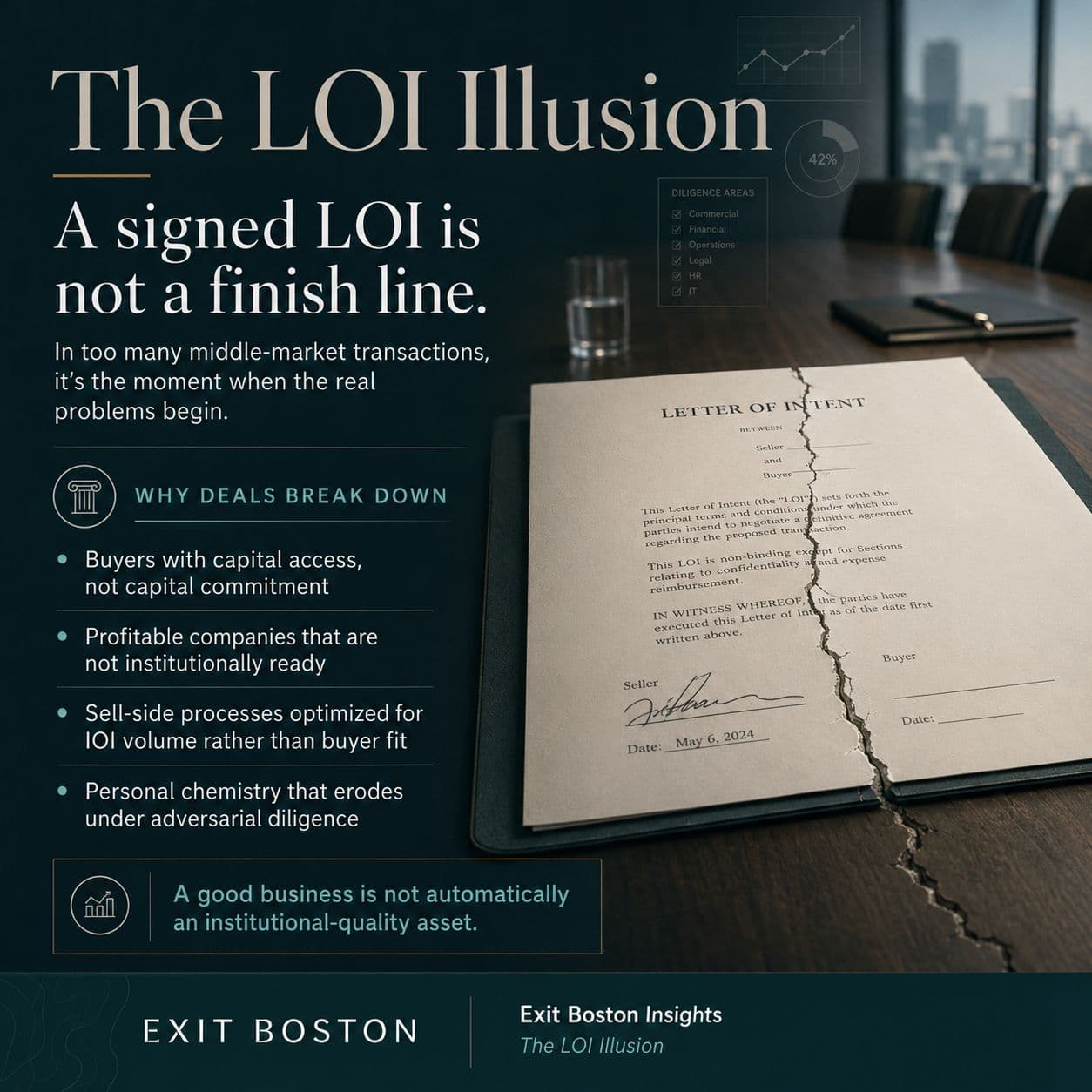
The LOI Illusion: Why More Middle-Market Deals Are Falling Apart After the Letter of Intent
There is a quiet but important shift taking place in the middle market. More businesses are coming to market. More buyers are showing interest. More letters of intent are being signed. And yet, a growing percentage of these transactions are not getting to close. The signed LOI is no longer the finish line. In many cases, it is the moment when the real problems begin.
Quick Answers
Why is a signed LOI not a guarantee the deal will close?
A signed LOI marks the beginning of diligence — not the end of the process. Buyers probe financials, operations, management, and culture under intense scrutiny. If the company is unprepared, the buyer unqualified, or the cultural fit poor, the deal can unravel. More LOIs are failing because more companies are going to market before they are ready and more buyers lack the capital certainty or operating experience to close.
What is a virtual private equity buyer in M&A?
A virtual private equity buyer is a young, highly educated PE professional pursuing lower-middle-market acquisitions without a committed fund. They may have relationships with family offices and lenders, but they source capital after signing an LOI — meaning the seller may have selected a buyer candidate, not a buyer with committed capital ready to close.
Why does due diligence kill so many middle-market deals?
Diligence exposes whether earnings are real, repeatable, transferable, and scalable. Quality of earnings may reveal overstated EBITDA, aggressive add-backs, or inconsistent revenue recognition. Operational diligence may reveal founder dependency. Customer diligence may reveal concentration risk. Any one of these issues can change a deal; several together can kill it.
The Rise of the Virtual Private Equity Buyer
One of the most important changes in the middle market is the rapid growth of young, highly educated, highly ambitious private equity professionals pursuing acquisitions in the lower middle market.
Many of them are impressive. They are smart, polished, analytical, and trained in the language of finance. They understand acquisition models, leverage, EBITDA adjustments, investor presentations, and the theoretical architecture of private equity value creation. They also believe they have access to capital. And in many cases, they do — relationships with family offices, independent investors, lenders, and pools of capital looking for exposure to the middle market.
But there is a meaningful difference between having access to capital and having committed capital. There is also a meaningful difference between understanding acquisition finance and understanding how to buy, operate, lead, and grow a real business. This distinction is becoming one of the major fault lines in the middle market.
A growing number of buyers are effectively virtual private equity firms. They do not have a committed fund. They do not always have deep industry experience. They may not have operating partners with practical management experience. They may not have a track record of closing and integrating companies. Their model is to identify a target, secure a signed LOI, wrap the company up under exclusivity, and then go source the capital required to close.
The seller believes they have selected a buyer. In reality, they may have selected a buyer candidate.
What is the difference between capital access and capital commitment in M&A?
A buyer who has capital, industry knowledge, operating maturity, and transaction experience can work through problems. A buyer who has only a model and a capital 'network' may not. The difference between access and commitment determines whether a signed LOI leads to a closing or a collapse.
More Sellers Are Rushing to Market Before They Are Ready
The second major force is coming from the seller side. More lower-middle-market companies have become meaningfully successful. Many have grown into the $2 million, $3 million, $4 million, and $5 million EBITDA range. They hear that private equity is interested. They hear that family offices want direct investments. They hear that multiples have expanded in attractive sectors. They hear that the middle market is full of buyers with money to deploy. So they rush to market.
The problem is that many of these companies are not ready. This is one of the most important truths in middle-market M&A: a good business is not automatically an institutional-quality asset.
Many founder-led companies are excellent businesses. They are profitable. They are respected. They may have loyal customers, hardworking employees, strong margins, and a long track record of survival and growth. But they are often still run like families.
That is not meant as an insult. It is often part of what made them successful. Founder-led companies are built on trust, instinct, loyalty, urgency, customer responsiveness, and personal accountability. But institutional buyers do not acquire memories, instincts, and family culture. They acquire systems, earnings, leadership teams, repeatable processes, transferable customer relationships, recurring or predictable revenue, margin visibility, and credible growth pathways. That is where the gap appears.
Why Diligence Is Exposing More Problems
The diligence process is where attractive stories either become underwritable companies or begin to unravel. A buyer does not simply ask whether the company has made money. The buyer asks whether the earnings are real, repeatable, transferable, and scalable. That is a very different question.
Quality of earnings may reveal that EBITDA was overstated, add-backs were too aggressive, margins were temporarily inflated, owner expenses were not as clean as expected, or revenue recognition was inconsistent. Operational diligence may reveal that the founder is still central to sales, pricing, customer relationships, and daily decision making. Customer diligence may reveal that revenue is concentrated, contracts are weak, and relationships are informal. Management diligence may reveal loyal employees, but not a true leadership team capable of operating independently under new ownership.
Growth diligence may reveal that the projected expansion plan is more aspiration than executable strategy. Financial diligence may reveal that reporting is late, inconsistent, cash-basis, or disconnected from operating KPIs. Cultural diligence may reveal that the buyer and seller do not trust one another — or that the buyer does not understand the human reality of the business it is trying to acquire.
Any one of these issues can change a deal. Several of them together can kill it. This is why more LOIs are failing — not because the businesses are necessarily bad, but because the institutional underwriting case is not strong enough.
Round Pegs Are Being Forced into Square Holes
There is another issue that does not get enough attention: buyer selection. Too many processes are built around volume rather than fit. The goal becomes generating as many indications of interest as possible, rather than identifying the buyers who are actually qualified, capable, culturally appropriate, and strategically suited to own the company. That is a mistake — and it is one that sell-side advisors bear more responsibility for than the industry typically acknowledges.
The right buyer is not simply the buyer with the highest preliminary number. The right buyer is the buyer who understands the industry, respects the people, has the capital to close, has the experience to execute, and has a credible plan for the company after closing.
Too many sell-side advisors optimize for the IOI stage. They run wide processes, generate the most paper, and present the client with a stack of interest letters as evidence of market validation. But the quality of that buyer pool — their capital certainty, their sector experience, their operating DNA, their cultural fit with the company they are trying to acquire — rarely receives the same disciplined attention as the headline valuation. The result is a process that looks strong on the surface and breaks down under the pressure of extended diligence.
A sophisticated buyer selection process asks different questions. Not just: who will pay the most? But: who has closed deals like this before? Who has operated in this industry? Who has the capital structure that matches the deal? Who has a post-close plan that the management team can actually believe in? And critically — who is the kind of person, and the kind of organization, that this founder can sit across a table from for sixty to ninety days without the relationship deteriorating?
Why Personal Chemistry Is a Closing Mechanism
That last question is not soft. It is structural. Because the due diligence period is long, and it is stressful, and it is adversarial by design. Buyers probe. Sellers defend. Adjustments are proposed, challenged, and negotiated. Lawyers insert themselves. Representations get debated. The company is examined at a level of granularity that no founder has ever experienced — and most find deeply uncomfortable.
In that environment, personal chemistry is not a luxury. It is a closing mechanism.
When the buyer and seller genuinely respect one another — when there is shared language, aligned values, and a believable vision for what comes next — the friction of diligence becomes manageable. Problems surface, get resolved, and the transaction moves forward. When that chemistry is absent, every problem becomes a flashpoint. Every adjustment becomes a confrontation. Every delay becomes evidence of bad faith. And slowly, sometimes invisibly, one side or the other begins looking for an exit.
Most broken deals do not end with a dramatic collapse. They end with exhaustion. One morning, the buyer stops returning calls with the same urgency. The seller's attorney starts using sharper language. The weekly check-in that used to run an hour now ends in twenty minutes. Nobody says the deal is dead. But everyone in the room knows the energy has shifted — and that the gap between the parties has become less about price and more about something harder to name.
That something is trust. And once it erodes under the pressure of diligence, it rarely comes back.
The Seven Pillars: The Architecture of Closeability
At Exit Boston, we do not believe founder-led businesses should be rushed to market simply because buyers are active or capital appears available. The question is not whether the company can attract interest. The question is whether the company is ready to close.
EXIT-BOSTON developed the Seven Pillars of Institutional Value as a diagnostic and preparation framework — a structured lens through which any middle market business can be evaluated, improved, and positioned for maximum value in an institutional sale process. These pillars are not theoretical. They are derived from what buyers — private equity partners, strategic acquirers, and sophisticated family offices — actually ask, actually underwrite, and actually pay for.
The framework is built on a single, durable insight: buyers do not pay for history. They pay for certainty — certainty that revenue will hold, that the team will execute, that margins are real, and that the growth they are paying for is actually achievable. The Seven Pillars are the map for creating that certainty before a buyer ever enters the room.
- 1Owner Independence — What breaks if the owner steps away? A business dependent on its founder is not transferable — it is employment risk.
- 2Management Depth & Accountability — Who is actually running this business post-close? Buyers don't scale businesses — they scale teams.
- 3Financial Clarity & Data Discipline — Can we trust the numbers — and can we model the future? The Quality of Earnings process will find everything.
- 4Margin Quality & Visibility — Are margins sustainable — or are we buying risk? Visible, durable margins support premium multiples.
- 5Recurring & Predictable Revenue — How much of next year's revenue is already visible? Retention rates are among the most powerful valuation levers.
- 6Technology & Operating Infrastructure — Will this business scale — or will it break under growth? System-driven businesses attract institutional capital.
- 7Growth Pathways — Where do we put capital — and what does that return? Defined pathways create competition and multiple expansion.
Exit Boston's View: The Best Deals Are Engineered Before Market
This is why Exit Boston does not play in the world of broken, poorly prepared, poorly matched transactions. We are not interested in simply pushing a company into the market, collecting IOIs, chasing the highest headline LOI, and hoping the deal survives.
Hope is not a process.
Our work is to understand the company before the buyer does. We want to know where the company is strong, where it is exposed, where the buyer will push, where diligence will test the story, and where the owner needs to prepare before going to market. We believe successful outcomes are engineered.
That means preparing the company through the lens of the buyer. It means identifying the right buyers, not just the most buyers. It means understanding culture, capital, industry experience, and post-close fit. It means making sure the buyer can execute, not merely express interest. And it means taking buyer curation seriously as a professional discipline — not as an afterthought, not as a volume exercise, but as a deliberate matching process that considers structure, sector experience, operating capability, and the personal chemistry that will either hold a deal together or quietly pull it apart over sixty days of diligence.
The Real Lesson for Business Owners
For owners of successful founder-led businesses, the lesson is clear.
Do not confuse buyer interest with buyer certainty. Do not confuse a high LOI with a closed deal. Do not confuse capital availability with buyer capability. And do not confuse a good business with an institutional-quality asset.
The middle market still rewards great companies. But it increasingly punishes companies that are unprepared, poorly positioned, loosely managed, overly dependent on the owner, or matched with the wrong buyer.
The companies that win will be the ones that prepare before market. They will understand their weaknesses before buyers discover them. They will build management depth before diligence exposes the gap. They will clean up financial reporting before QoE challenges EBITDA. They will define growth pathways before buyers question the future. They will select buyers based not only on price, but on capital, capability, culture, and fit. And they will choose an advisor who is as disciplined about buyer qualification as they are about company preparation — because both matter, and both determine whether a deal actually closes.
The middle market does not need more rushed processes. It needs better-prepared companies, better-qualified buyers, and better-engineered transactions. That is where real value is created. And that is where deals actually close.
Key Takeaways
- A signed LOI is no longer the finish line — in many cases, it is the moment when the real problems begin.
- The rise of virtual PE buyers means more LOIs are signed by buyer candidates who still need to source capital, not committed acquirers.
- A good business is not automatically an institutional-quality asset. Profitable companies often still run like families, creating gaps that diligence exposes.
- Buyer selection based on volume rather than fit is one of the most underappreciated causes of deal failure.
- Personal chemistry between buyer and seller is not a luxury — it is a closing mechanism that determines whether diligence friction becomes manageable or fatal.
- The companies that win will prepare before market, understand their weaknesses before buyers discover them, and choose advisors as disciplined about buyer qualification as company preparation.
Frequently Asked Questions
What percentage of signed LOIs actually close?
How can a founder tell if a buyer is truly qualified?
What are the Seven Pillars of Institutional Value?
What is the most important thing a founder can do before going to market?
Preparing Your Business for Exit?
Exit Boston helps founder-led businesses build institutional quality, align leadership teams, and execute transactions that reflect true value.
Schedule a Confidential Consultation