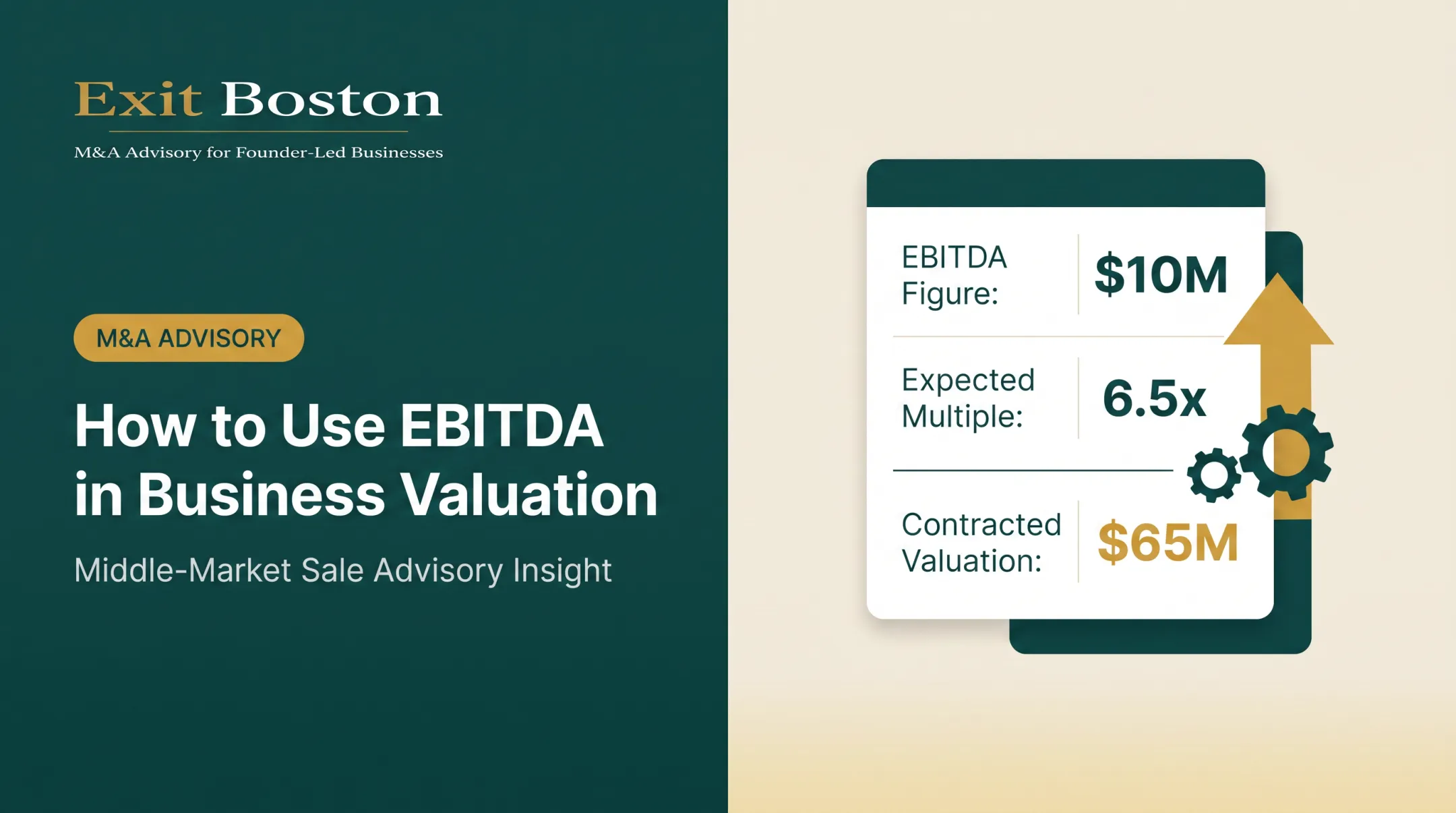

Many founders underestimate what their business is worth simply because they don't know how to calculate or present this figure correctly. A missed addback, or an aggressive one that doesn't hold up, can swing purchase price by hundreds of thousands of dollars.
This guide breaks down the adjusted EBITDA formula, the calculation steps, the most common adjustments, and a full worked example so you know exactly what buyers are looking at.
Key Takeaways
- Adjusted EBITDA strips one-time, non-recurring, and owner-specific items so earnings reflect ongoing operations
- Buyers apply valuation multiples directly to this figure, so every addback changes purchase price
- No standardized formula exists, so every adjustment has to be reasonable, defensible and documented
- Typical addbacks cover excess owner pay, personal expenses, one-time legal fees, and related-party rent
What Is Adjusted EBITDA?
EBITDA stands for Earnings Before Interest, Taxes, Depreciation, and Amortization. It's a starting point for measuring a company's operating profitability, stripped of financing decisions, tax structures, and non-cash accounting entries.
Adjusted EBITDA goes a step further. It normalizes EBITDA for items that don't reflect the ongoing, sustainable earning power of the business. Common examples include:
- One-time lawsuit settlements
- An owner's above-market salary
- A family member on payroll who doesn't actually work there
Here's the part sellers often miss: adjusted EBITDA is a non-GAAP measure. The SEC's own guidance confirms there's no standardized adjustment list, and these measures aren't always comparable across companies. That means the burden falls on you (and your advisors) to build a defensible, well-supported schedule rather than pulling addbacks from a generic checklist.
The Adjusted EBITDA Formula and Calculation
Starting With Base EBITDA
The base formula is straightforward:
EBITDA = Net Income + Interest + Taxes + Depreciation + Amortization
Or, if you're starting from operating income:
EBITDA = Operating Income + Depreciation + Amortization
Layering in Adjustments
Once you have base EBITDA, layer in normalizing items:
Adjusted EBITDA = EBITDA +/- Normalizing Adjustments
Adjustments run in both directions:
- Positive addbacks increase EBITDA: one-time legal settlements, excess owner compensation
- Negative adjustments decrease EBITDA: the cost of hiring a replacement manager the buyer will need post-sale

CFI's example shows how the stack builds:
- Start with net income of $25,000
- Add taxes ($4,500), interest ($3,250), and D&A ($12,800) → EBITDA of $45,550
- Add back a $15,000 goodwill impairment, reverse a $9,500 gain on asset sale, and adjust for stock-based compensation and FX losses → adjusted EBITDA of $53,650
Why Every Dollar Counts
This is the piece that trips up sellers who haven't been through a sale before: each addback dollar gets multiplied by the deal multiple.
A $50,000 addback at a 5x multiple doesn't just add $50,000 to your pocket. It adds $250,000 to the purchase price. That's why buyers scrutinize every line, and why sloppy or unsupported adjustments cost you real money in negotiations.

Common Adjustments Made to EBITDA
Institutional buyers work from a short list. The Real Exit names four categories in both Ch.16 and Appendix C, and these are the ones a private equity buyer expects to see documented:
- Owner compensation above market levels
- Personal expenses recorded through the company
- One-time legal or consulting fees
- Non-recurring operational disruptions
In practice the schedule you build will be longer, because the categories below all resolve into those four:
- Owner and executive compensation: above or below market salary, or family members on payroll who aren't actively involved
- Personal expenses run through the business: vehicles, travel, insurance policies, club memberships
- Related-party rent: lease terms with an affiliated landlord that differ from fair market value
- One-time professional fees: legal, accounting, or M&A costs tied to a lawsuit or transaction
- Non-cash items: stock-based compensation, unrealized gains or losses, goodwill impairments
- Management gaps: a negative adjustment when the buyer will need to hire someone the seller currently isn't paying for
Grant Thornton notes that buyers test each item by asking a simple question: would the seller still make this adjustment if they were keeping the business? Adjustments that don't pass that test tend to get challenged or rejected outright during diligence.

Why Adjusted EBITDA Matters in a Business Sale
Private equity firms and strategic buyers don't negotiate off gut feel. They apply an EV/Adjusted EBITDA multiple to set purchase price, and that multiple moves with market conditions.
GF Data's Q3 2025 report shows the average purchase-price multiple for private-equity-sponsored deals hit 7.5x trailing-12-month adjusted EBITDA, up from 6.9x in Q2. Separately, Capstone Partners reported average middle-market EV/EBITDA at 9.4x in 2024.
These figures come from different samples and methodologies, but the message is consistent: your multiple applies to adjusted EBITDA, not revenue.
Adjusted EBITDA also improves comparability. It lets buyers evaluate companies with different capital structures, tax situations, or ownership styles on a level playing field.
But there's a trap. Overly aggressive addbacks invite scrutiny. When a buyer catches one shaky adjustment, they start questioning all of them, and that erodes trust right when you need negotiating leverage most.
This is where preparation matters. At Exit Boston, we work with founder-led, middle-market companies generating $10 million to $100 million in revenue to build adjusted EBITDA schedules that hold up under institutional buyer diligence.
The label company case in The Real Exit shows what that is worth. The business initially struggled to clear a 4.8x multiple because buyers flagged founder dependence and unclear management incentives. After roughly six months of institutional-readiness preparation:
- Sold at 6.4x adjusted EBITDA of $3.4 million, an enterprise value of $21.76 million
- EBITDA grew from $3.4 million to $9.0 million over the following 4.5 years, largely through bolt-on acquisitions
- The platform exited at 8.2x, and the founder's retained 20% stake was worth $14.76 million at that second sale
The founder's early expectation was roughly $16 million. The total realized outcome was $32.17 million. None of that arithmetic works without a defensible adjusted EBITDA figure at the front of it.
What the Quality of Earnings Review Actually Tests
Your schedule does not get graded by the buyer. It gets graded by an independent accounting firm the buyer hires to perform a Quality of Earnings analysis, usually after the letter of intent is signed and exclusivity has started, which is the worst possible moment to lose an argument.
A QoE review examines six things:
- Revenue recognition practices
- Customer concentration
- One-time expenses
- Owner compensation adjustments
- Non-recurring items
- Working capital requirements
If the review disagrees with your numbers, the buyer revises the normalized EBITDA used in the purchase price calculation. This is not a rare outcome. In Axial's 2025 Dead Deal Report, quality of earnings discrepancies over EBITDA rose from 10.6% of broken letters of intent in 2023 to 21.3% in 2025, roughly doubling in two years, while other diligence findings rose from 19.1% to 25.3%. Over the same period financing-related failures fell from 21.3% to 10.7%. Capital got easier; earnings quality got harder.
The practical implication: the quality of earnings process will find everything, so the question is whether you found it first. A sell-side QoE, commissioned before you go to market, is how sellers move that argument to a point in the process where they still have leverage.
Adjusted EBITDA Calculation: Example Walkthrough
Let's walk through a simplified example for a $15 million-revenue manufacturing company.
Step 1: Start with net income
| Line Item | Amount |
|---|---|
| Revenue | $15,000,000 |
| Total costs and expenses | ($13,200,000) |
| Net Income | $1,800,000 |
Step 2: Build up to EBITDA
| Component | Amount |
|---|---|
| Net Income | $1,800,000 |
| Interest expense | $350,000 |
| Taxes | $420,000 |
| Depreciation & amortization | $680,000 |
| EBITDA | $3,250,000 |
Step 3: Apply normalizing adjustments
| Adjustment | Amount |
|---|---|
| One-time litigation settlement | $180,000 |
| Excess owner salary above market rate | $220,000 |
| Non-recurring restructuring costs | $150,000 |
| Adjusted EBITDA | $3,800,000 |
Step 4: Apply the market multiple
At a 6.5x multiple, that $3,800,000 in adjusted EBITDA translates to an estimated enterprise value of $24.7 million. Compare that to a valuation based on unadjusted EBITDA of $3,250,000, which lands at roughly $21.1 million. The adjustments alone accounted for a $3.6 million swing.

Step 5: Remember that enterprise value is not proceeds
Adjusted EBITDA times a multiple gives enterprise value. What reaches the shareholders is equity value, and debt and cash sit between the two. The Real Exit works the bridge like this:
| Line | Amount |
|---|---|
| Enterprise value | $20,400,000 |
| Debt | ($5,000,000) |
| Cash | +$1,000,000 |
| Equity value | $16,400,000 |
Transaction costs and any rollover equity come off that figure again. Two companies with identical adjusted EBITDA can write very different checks to their sellers.
The common mistake? Sellers either over-adjust, claiming addbacks that won't survive diligence, or fail to document the rationale behind each one. Every adjustment needs a paper trail:
- An invoice supporting the one-time cost
- A market-rate comparison for owner compensation
- A dated event tied to the non-recurring item
Without it, buyers strip the addback out and your valuation drops.
Conclusion
Adjusted EBITDA is the core driver of valuation in nearly every middle-market business sale. Getting the calculation right protects your credibility with buyers and directly protects your purchase price. Sloppy addbacks cost you leverage; well-documented ones win it back.
If you're considering a sale in the next one to three years, work with an experienced M&A advisor to build a defensible adjusted EBITDA schedule before you go to market. At Exit Boston, we help founders in manufacturing, distribution, and food and beverage build that schedule before a deal ever reaches the table.
Frequently Asked Questions
What is a good adjusted EBITDA percentage?
It varies by industry, but a 15-25% adjusted EBITDA margin is generally considered solid for middle-market companies. Premium businesses in high-margin sectors often exceed that range.
What is the difference between EBITDA and adjusted EBITDA?
EBITDA is a standardized calculation built from net income, interest, taxes, and D&A. Adjusted EBITDA takes that figure further, normalizing for one-time, non-recurring, or owner-specific items.
Is adjusted EBITDA a GAAP measure?
No. It's a non-GAAP measure with no standardized adjustment list, according to SEC guidance. Any EBITDA-based performance measure should be reconciled back to net income.
How do buyers use adjusted EBITDA to value a business?
Buyers apply an industry-specific multiple to your adjusted EBITDA to estimate enterprise value and set the purchase price. That's why the accuracy of this figure matters so much.
Can adjusted EBITDA be manipulated?
Yes, since there's no standard adjustment list, some sellers use aggressive addbacks to inflate earnings. Buyers scrutinize each item closely, and unsupported adjustments usually get removed during diligence.
Who should prepare the adjusted EBITDA schedule before a sale?
Sellers should work with their accountant and an M&A advisor together to identify and document every legitimate addback before going to market. Both perspectives help build a schedule that holds up under buyer review.