
Many founders treat this document like a marketing brochure. Glossy, enthusiastic, thin on substance. Institutional buyers expect something closer to an investment thesis: rigorous, evidence-backed, and built to survive scrutiny.
This article covers what to include, how to present financials credibly, and delivery practices that separate amateur decks from ones that drive competitive offers.
Key Takeaways
- Pair compelling storytelling with rigorous financial and operational data to earn buyer confidence
- Show management strength, market position, and growth potential, not only historical performance
- Treat confidentiality controls, clean design, and a clear next-step CTA as non-negotiables
- Work with an experienced M&A advisor to position the business as an institutional-quality asset
What Is a Sales Presentation When Selling a Business?
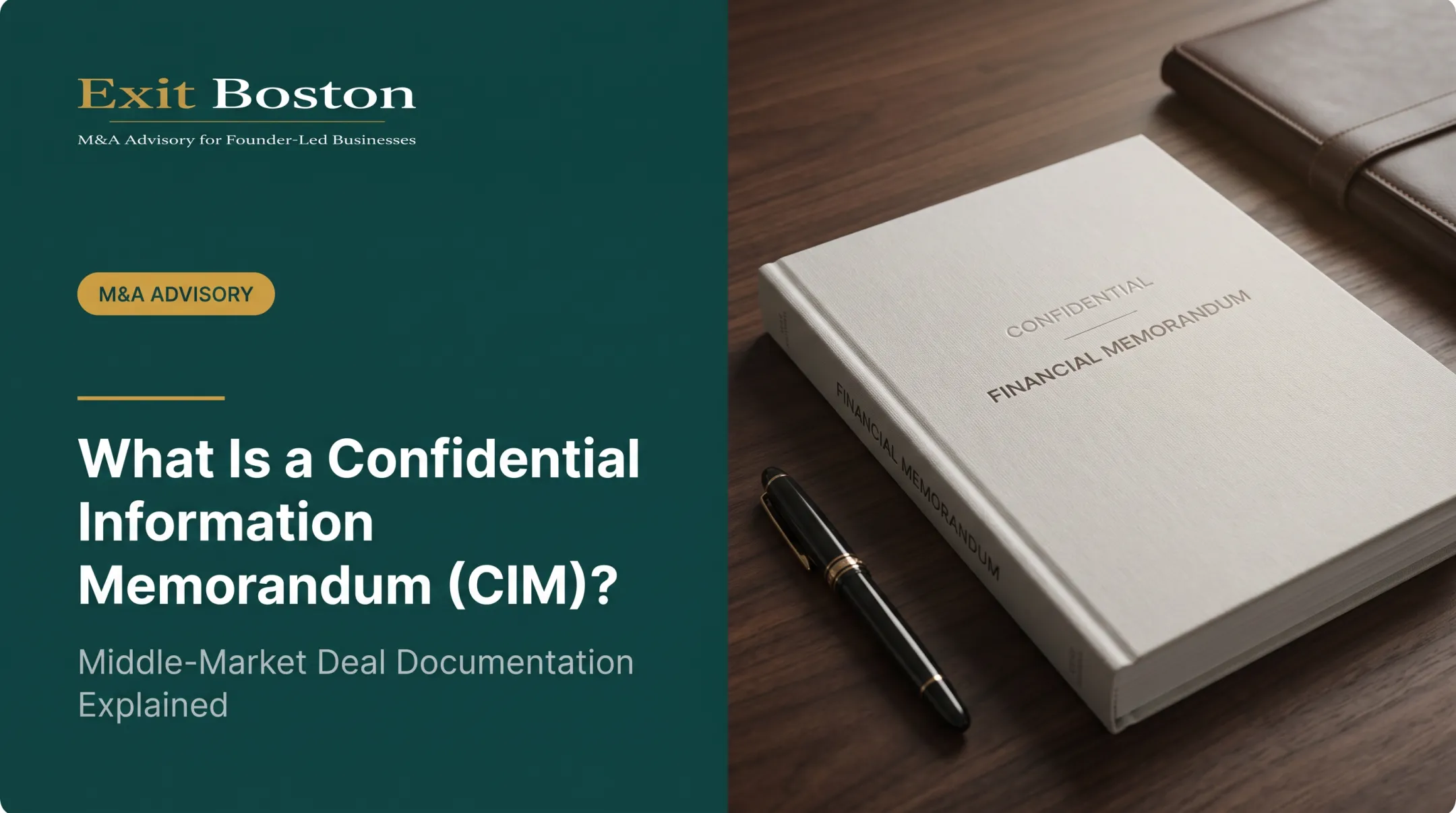
In an M&A context, your "sales presentation" usually isn't a single deck. It's a Confidential Information Memorandum (CIM) or Investment Summary, and it's a different animal than a typical product pitch.
Its job: spark serious buyer interest while protecting sensitive information until buyers have earned access to it.
According to Corporate Finance Institute, the process typically starts with an investment teaser, a one- or two-page, anonymized summary distributed broadly to gauge interest without revealing the company's identity.
Because it goes out before any confidentiality agreement is signed, the teaser withholds the name and carries six things instead:
- The industry
- General location
- Revenue range
- EBITDA range
- Core products or services
- Key growth opportunities
Its one job is to make a buyer want to know more, which is why it leads with whatever is genuinely compelling: strong margins, recurring revenue, leadership of a defined niche, or a clear growth path.
Once a buyer expresses genuine interest and signs a non-disclosure agreement, they receive the full CIM. A well-prepared one runs to nine standard sections:
- Company history
- Industry overview
- Products and services
- Customer relationships
- Management team
- Financial performance
- Growth strategy
- Acquisition opportunities
- Risks and mitigants
Covering those nine is table stakes. What separates a CIM that draws offers from one that draws polite passes is that it reads as a strategic narrative rather than a data dump: why the company has succeeded, why its market position holds, and how it grows under new ownership. Institutional investors read every CIM with one question in mind, and it is not "is this a good business". It is can this company become significantly more valuable in the future.
The distinction matters:
- Teaser: broad distribution, no company name, hooks interest
- Full CIM: narrow distribution, NDA-gated, detailed enough to support an initial offer

Essential Components Every Business Sale Presentation Must Include
A buyer-ready sale presentation covers six core sections. Each one answers a question sophisticated buyers will ask before they commit capital.
Executive Summary
This is the hook. A high-level snapshot of the business, key financials, and investment highlights that make a buyer want to keep reading. Include revenue and EBITDA trends, the investment thesis, and why the business is being brought to market now.
At Exit Boston, this section typically foregrounds hard numbers, EBITDA growth, margin trends, and valuation multiples, because sophisticated buyers scan for evidence before they scan for narrative.
Company & Operations Overview
Cover business history, core operations, facilities, and any proprietary systems or technology that set the company apart. For manufacturing or distribution businesses, this might mean documented SOPs, production capacity, or supply-chain relationships. For food and beverage brands, it could mean distribution reach or formulation IP.
Buyers want to know: does the operation run on repeatable systems, or does it run on one person's memory?
Market Position & Competitive Landscape
Research and present:
- Market size and growth trends
- Competitive dynamics and where the company ranks
- Barriers to entry that protect the business
Grounding this section in precedent transactions and buyer-specific criteria (rather than generic industry stats) makes it far more credible to a private equity investment committee.
Growth Opportunities
Show buyers the upside they're paying for. Untapped markets, product line expansion, or operational improvements that increase EBITDA post-close.
Real examples matter more than adjectives. One label-manufacturing client grew EBITDA from $3.4 million to $9.0 million through three bolt-on acquisitions over 4.5 years, a documented growth path buyers can underwrite.

Management Team & Succession
Buyers scrutinize leadership depth because founder dependency signals risk. Address three questions directly:
- Can the company run if the founder leaves?
- Is there a real leadership team in place, not just the founder's direct reports?
- Is there a credible transition plan?
Leadership depth and founder transition planning are frequently cited as top drivers of valuation multiple expansion. A structured, time-bound transition commitment (say, two years) reduces perceived risk far more than vague reassurances.
Risks & Mitigation
Address key risks transparently, covering customer concentration, key-person dependency and market cyclicality, and explain how each has been managed. Buyers will find these issues in diligence regardless. Surfacing them first builds trust and prevents late-stage renegotiation.
Presenting Financials and Value Drivers to Build Buyer Confidence
Financials make or break buyer confidence faster than any other section.
What to include:
- 3+ years of historical financials (income statement, balance sheet, cash flow), normalized for one-time or owner-related expenses
- EBITDA, gross margin, and recurring revenue, the metrics institutional buyers weigh most heavily
- Simple charts and trend lines instead of dense spreadsheets
- Realistic, defensible forward-looking projections
Buyers rarely accept reported EBITDA at face value. According to CohnReznick, adjustments for non-recurring items, non-operating expenses, and owner compensation are standard.
Unsupported or inconsistent add-backs invite pushback. Every adjustment needs a schedule and a defensible rationale.

Overly optimistic forecasts undermine credibility fast. If growth assumptions aren't tied to signed contracts, documented pipeline, or historical precedent, buyers discount them, and sometimes the whole document.
Value drivers to highlight:
- Customer concentration and retention trends
- Recurring or contracted revenue mix
- Management depth beyond the founder
- Documented processes buyers can transfer
Third-party-prepared financials carry more credibility with sophisticated buyers than owner-prepared numbers. They remove the "seller grading their own homework" problem.
Exit Boston's co-founder Steve Vesey, a CPA with more than 25 years preparing business valuations, brings that independent rigor to client engagements.
The Management Presentation: Where Buyers Judge the People
Documents get you the meeting. The meeting is a different test.
Once buyers have read the CIM and decided the opportunity warrants deeper investigation, the next stage is usually a management presentation, with the leadership team, often led by the founder, presenting the business directly to potential investors. It is one of the most important stages of the entire transaction.
The presentation itself typically covers strategy, market positioning, operational strengths, growth opportunities, and acquisition potential. But the investors in the room have already read the financial statements and the strategic materials. What they are doing now is evaluating the leadership team against three questions:
- Can they communicate clearly?
- Do they understand their industry deeply?
- Do they appear capable of leading a larger organization?
This is why the management section of the CIM has to be honest. A document claiming real bench strength and a presentation where the founder answers every question do not survive each other. A strong management presentation can move investor confidence sharply upward; a weak one quietly undoes the document that earned the meeting.
Delivery Best Practices and Common Mistakes to Avoid
Design principles:
- Keep it visually clean: charts and callouts, not walls of text
- Push fine print and detailed schedules to an appendix
- Maintain consistent formatting throughout
Tailor tone to buyer type. Clean design only goes so far, and different buyers read the same deck for different reasons:
- Strategic acquirer: synergy and integration logic
- Private equity firm: standalone cash flow and scalability
- Family office: continuity, culture, and a longer time horizon

The same document rarely serves all three equally well.
Common mistakes to avoid:
- Oversharing sensitive details (customer lists, pricing, proprietary processes) before an NDA is signed
- Presenting growth projections with no supporting evidence
- Disorganized or inconsistent financials across sections
- No clear next step or call to action at the end
A CIM that ends without directing the reader toward a specific action, submitting an indication of interest or scheduling a call, wastes the momentum it just built.
Why Founders Work With an M&A Advisor to Build Their Sales Presentation
Building an institutional-quality CIM requires skills most founders haven't spent a career developing: transaction marketing, financial storytelling, and a feel for what buyers respond to. Exit Boston's team splits this work by specialty:
- Thor, Director of Transaction Marketing & Investor Relations, builds CIMs, teasers, and investor presentations tailored to each buyer's acquisition criteria
- Laura, Senior Research Analyst, maps the competitive landscape and identifies the buyer universe That buyer universe typically includes:
- Private equity firms
- Strategic acquirers
- Family offices The presentation then speaks directly to who is most likely to pay a premium. Outreach is the other half of the work. Rather than waiting for investors to find the opportunity, the advisor introduces it individually to a curated group matching the buyer profile defined beforehand, then moves interested parties through the process in a deliberate sequence.
That sequence exists to create competitive tension, and competitive tension is the mechanism, not the mood. When several investors are pursuing the same company, each one knows that moving slowly may cost them the deal. Without competition, a single buyer has every reason to take its time and negotiate hard. That is often what separates an acceptable offer from a premium one. An outside advisor also catches what founders can't see from inside their own business: operational gaps, an underplayed growth story, or risks that need addressing before a buyer finds them first.
Frequently Asked Questions
What is the 5-5-5 rule for effective presentation design?
The 5-5-5 rule suggests five words per line, five lines per slide, and no more than five consecutive text-heavy slides. It's a useful readability guideline, not a rigid law, for keeping a presentation focused.
How long should a business sale presentation be?
Length varies by business complexity. Teasers are typically one to two pages, while full CIMs run from a concise executive summary to 50-plus pages, depending on operational and financial depth.
Who should see the full sales presentation versus a teaser?
Teasers are anonymized and shared broadly to gauge interest without revealing the company's identity. Full CIMs go only to qualified buyers who've signed an NDA.
Should I include my asking price in the presentation?
Many CIMs omit a fixed asking price to encourage competitive bidding, while still providing enough financial context for buyers to size an offer. This keeps negotiating leverage with the seller.
How do I protect confidential information while still attracting buyer interest?
Use NDAs before sharing sensitive data, release information in stages as buyers prove seriousness, and work with an advisor to vet buyers before granting deeper access.
Can I create the sales presentation myself, or should I hire a professional?
Founders can draft an initial version, but professional advisors bring valuation expertise, buyer psychology insight, and objectivity that shape how buyers perceive and price the opportunity.