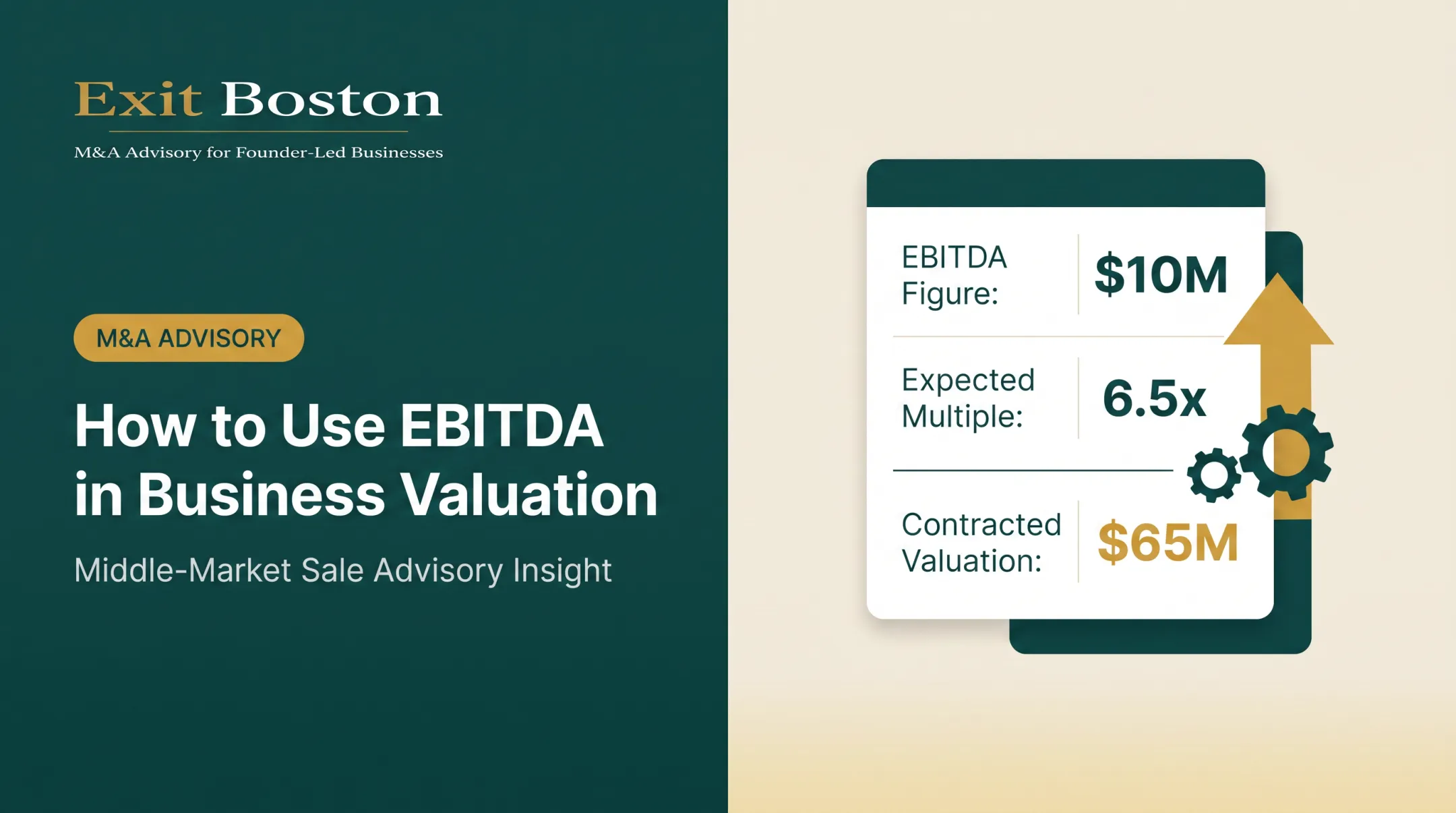

Enterprise value is EBITDA multiplied by a multiple, and the multiple is the half most founders never manage. Harrison Aerospace, the New Hampshire precision aerospace machining business documented in Exit Boston's book The Real Exit, first went to market at roughly 6.0x on approximately $8.5 million of EBITDA. Its founder paused the process, spent several months closing institutional gaps, and returned with the same $8.5 million of EBITDA. It transacted at 7.2x. Nothing about profitability changed. More than $10 million of enterprise value did.
This guide covers which drivers set the multiple and the sequence that moves it. Both Harrison figures below are calculated from the same earnings: $8.5 million at 6.0x is $51 million, and at 7.2x it is $61.2 million.
Key Takeaways
- Enterprise value is EBITDA times a multiple, and the multiple is usually the cheaper half to move
- Harrison Aerospace went from 6.0x to 7.2x, $51 million to $61.2 million, on unchanged $8.5 million EBITDA
- Buyers are not rewarding history; they are pricing the work they expect to do after closing
- Preparation takes four to six quarters to appear in the trailing record, so start 2-3 years before an exit
What Is a Business Valuation?
A business valuation determines what your company is economically worth, whether for a sale, a recapitalization, a partner buyout, or succession planning. That figure reflects risk: the lower the perceived risk, the higher the price a buyer will pay for the same earnings.
Valuations generally rely on one of three approaches:
- Income-based: projects future cash flow and discounts it to present value
- Market-based: compares your company to similar businesses that recently sold
- Asset-based: totals tangible and intangible assets, more common for asset-heavy or distressed businesses
For most middle-market companies, valuation comes down to an EBITDA multiple: adjusted EBITDA multiplied by a factor reflecting industry, size, growth, and risk.
What Counts as a "Good" Multiple?
There's no universal number, and multiples vary widely. According to GF Data's Q3 2025 report covering private-equity-sponsored transactions, the average purchase price hit 7.5x trailing-12-month EBITDA, up from 6.9x the prior quarter.
Exit Boston's market brief The Automation Divide, drawn from observed and transacted activity in the $10 million to $100 million transaction-value segment between 2024 and mid-2026 and explicitly not a valuation or appraisal, sorts New England metal fabricators into three bands on an adjusted EBITDA basis: 8.0x to 9.0x for the rare exceptional business, 4.5x to 6.0x for the solid mid-market operator, and 4.0x to 4.5x or unplaceable for anything behind the curve.
The width is the story. On $3 million of adjusted EBITDA, the gap between five and a half turns and eight and a half turns is roughly $9 million of enterprise value.
The Multiple Moves Further Than the Earnings Do
Chapter 5 of The Real Exit makes the point with two companies that earn exactly the same money.
Company A produces $4,000,000 of EBITDA and trades at 5x, so its enterprise value is $20,000,000. Company B produces $4,000,000 of EBITDA and trades at 8x, so its enterprise value is $32,000,000. Identical earnings, $12 million apart.

RSM notes that transactions within the same industry and size range often show a three-to-four-turn spread, amounting to a 70%-80% difference between low and high transaction values. Preparation, not luck, explains most of that gap.
Harrison Aerospace is that arithmetic with a name attached. Early indications clustered at 6.0x, which on $8.5 million of EBITDA implies about $51 million. Those indications were not an insult, as the book puts it. They were a signal. Buyers were not discounting the machines or the customers. They were pricing four conditions: decisions concentrated with the founder, limited management depth beneath ownership, reporting built for internal management rather than institutional review, and incentives only loosely aligned with long-term growth.
At 7.2x, the same $8.5 million was worth $61.2 million. That 1.2 turns of expansion is the cheapest enterprise value a founder will ever create, because it costs preparation rather than performance.
The same multiple governs outcomes that have nothing to do with a sale: recapitalization leverage, partner buyouts priced without a dispute, and estate planning that survives review.
Core Value Drivers Buyers Actually Pay For
Buyers are not purchasing your earnings. They are purchasing certainty that those earnings continue without you. Exit Boston's Seven Pillars framework organises that certainty as seven buyer questions.
Owner Dependency Is the Silent Killer
The first pillar, Owner Independence, asks one question: what breaks if the owner steps away? A business dependent on its founder is not transferable. It is employment risk.
Institutional buyers work the question three ways:
- Can the company keep operating if the founder leaves?
- Is there a real leadership team, or does the founder still carry critical responsibilities?
- Is there an actual transition plan in place?
Harrison's answers were weak on all three, and the multiple reflected it. Building a team that runs daily operations independently is the highest-leverage move most founders can make.
Customer Concentration Raises Risk
A common guideline suggests no single client should exceed 10% of revenue. Where a few customers carry a large share, investors cut the multiple to compensate for the risk.
Fix it by:
- Converting purchase orders into extended supply agreements
- Actively diversifying your customer base before you go to market
- Documenting contract terms and renewal history clearly
Recurring Revenue Beats One-Off Sales
Predictable revenue reduces risk, and lower risk supports a higher multiple. That is the whole mechanism:
- Contracted / recurring: multi-year supply agreements, retainers, subscriptions
- One-off / project: spot POs, single engagements, non-renewing work

One of the five things that changed on Harrison's second trip to market was simply customer contracts giving buyers forward revenue visibility.
Clean Financials Signal Low Risk
Buyers do not value reported EBITDA. They value adjusted EBITDA. The Real Exit works the example: reported EBITDA of $3,200,000, plus $200,000 of owner compensation above market, plus $75,000 of one-time legal fees, plus $125,000 of non-recurring equipment repair, gives adjusted EBITDA of $3,600,000.
RSM's research confirms sophisticated buyers build their own valuation range rather than trusting the seller's numbers. Every adjustment you cannot document is one a buyer will delete.
Differentiated Positioning Protects Pricing
Pricing power reflects brand strength, product differentiation, or limited competition, and it holds margin when costs move. Defensibility reduces perceived risk, and risk is what buyers price first.
Practical Steps to Increase Your Business Valuation
Here's the sequence that actually moves a multiple, not just top-line revenue.
- Get a baseline and set a target multiple. Harrison's baseline was the market's own 6.0x indication.
- Document and systematize operations. If institutional knowledge lives only in people's heads, buyers see fragility. Written SOPs signal scalability.
- Strengthen the management bench. Formalise and test roles, and delegate key client relationships. Buyers do not scale businesses, they scale teams.
- Rebuild reporting for institutional review. A quality of earnings review builds buyer confidence. ACG's 2025 analysis of 360 transactions found sellers using sell-side QoE averaged 7.4x TEV/EBITDA versus 7.0x for those without one. The lift was most pronounced above $50M in enterprise value.
- Build a credible growth pathway. Name the acquisition candidates or the adjacent markets. Limited growth caps valuation at a maintenance multiple.

None of these happen overnight. Exit Boston's preparation programme runs 18 to 24 months, and operational changes generally take four to six quarters to show up in the financial statements.
What Changed on the Investment Committee's Desk
When Harrison Aerospace returned to market, the numbers on the page were identical. Five things around them were not:
- A platform thesis backed by a named pipeline of acquisition candidates
- A management team whose roles and responsibilities had been formalised and tested
- Financial reporting structured for institutional review, not internal convenience
- Customer contracts providing revenue visibility across the forward planning horizon
- A founder willing to roll equity, signalling genuine confidence in what came next
The result was not a bidding war. It was a change of category: out of the founder-dependent operator bucket, where multiples cluster around 5x to 6x, and into the emerging institutional platform bucket, where price reflects what the company can become.
Category is also why process matters. Exit Boston's Senior Research Analyst, Laura, maps the buyer universe and profiles targets by acquisition criteria and transaction history, and Investment Summaries are written against each qualified buyer's stated criteria. Several acquirers enter at once, so no single buyer sets your price.
Common Mistakes That Hurt Valuation
- Rushing to market without preparation. Harrison's alternative was accepting 6.0x. Pausing instead was worth more than $10 million.
- Overly optimistic projections. Buyers stress-test every growth assumption. Once trust cracks, they either walk or demand a lower price.
- Neglecting governance and controls. Reporting built for internal management is not wrong, it is just not what an investment committee reads.
- Managing only the numerator. Revenue growth is real work, but a founder who ignores the multiple competes for the smaller of the two prizes.
Frequently Asked Questions
How do I increase the valuation of a company?
Work the multiple, not only the earnings. Reduce founder dependency, diversify customers, convert orders into contracts, and rebuild reporting for institutional review. Harrison Aerospace gained 1.2 turns doing exactly that.
What does business valuation mean?
Business valuation estimates what a company is worth to someone else. In the middle market that usually means adjusted EBITDA multiplied by a multiple that prices the risk a buyer sees in those earnings.
What is a good valuation multiple?
It depends on what a buyer believes they are buying. Exit Boston's observed New England fabrication ranges run 4.0x to 4.5x for businesses behind the curve and 8.0x to 9.0x for the rare exceptional one.
How long before selling should I start preparing to increase valuation?
Two to three years. Exit Boston's own preparation programme runs 18 to 24 months, and operational improvements typically take four to six quarters to appear in the financial statements buyers actually read.
Do I need a professional advisor to increase my business's valuation?
Owners can start alone, and should. But Harrison Aerospace paused a live process rather than accept 6.0x, which takes someone able to see the business the way an investment committee will.