
They think in adjusted EBITDA, sustainable cash flow, and risk. That gap in understanding causes more blown-up deals and disappointed sellers than almost anything else in the sale process. A founder who's built a $30 million revenue business with thin margins may be shocked to learn buyers are underwriting a fraction of what they expected.
This guide breaks down how PE firms actually calculate valuation: the metrics they trust, the methods they triangulate, and the factors separating a 4.8x multiple from an 8.2x one. It's written for founder-led, middle-market businesses generating $10 million to $100 million in revenue, particularly those weighing a sale or recapitalization in the next few years.
Key Takeaways
- PE buyers price deals on adjusted EBITDA multiples, not top-line revenue
- Buyers and advisors triangulate market, income, and precedent-transaction methods for a defensible number
- Competitive tension among buyers yields more offers and stronger negotiating leverage
- Owner dependency and customer concentration are two of the biggest silent discounts on your multiple
- Preparation years in advance, not months, is what separates average outcomes from premium ones
- A PE buyer solves backwards from its own exit, and its return has exactly two sources: EBITDA growth and multiple expansion
What Is Private Equity Valuation?
Private equity valuation is the process of estimating what a PE firm would pay to acquire a controlling or partial stake in your company. It's an estimate of enterprise value (the value of your operating business) and equity value (what's left after subtracting net debt), built around sustainable earnings, market evidence, risk, and the returns the buyer needs to hit.
Unlike public markets, there's no daily share price to reference. Private valuation depends on negotiated terms, limited financial transparency, and forward-looking assumptions about growth and risk. That is why two PE firms can look at the same business and land on meaningfully different numbers, and why the figure shifts with the buyer, deal structure, and market timing.
PE valuation blends two layers. Fundamental analysis covers your financial metrics, margins, and growth trajectory. Strategic considerations cover fit with the buyer's thesis, synergies with an existing platform, and how competitive the process is.
Key Metrics Used in Private Equity Valuations
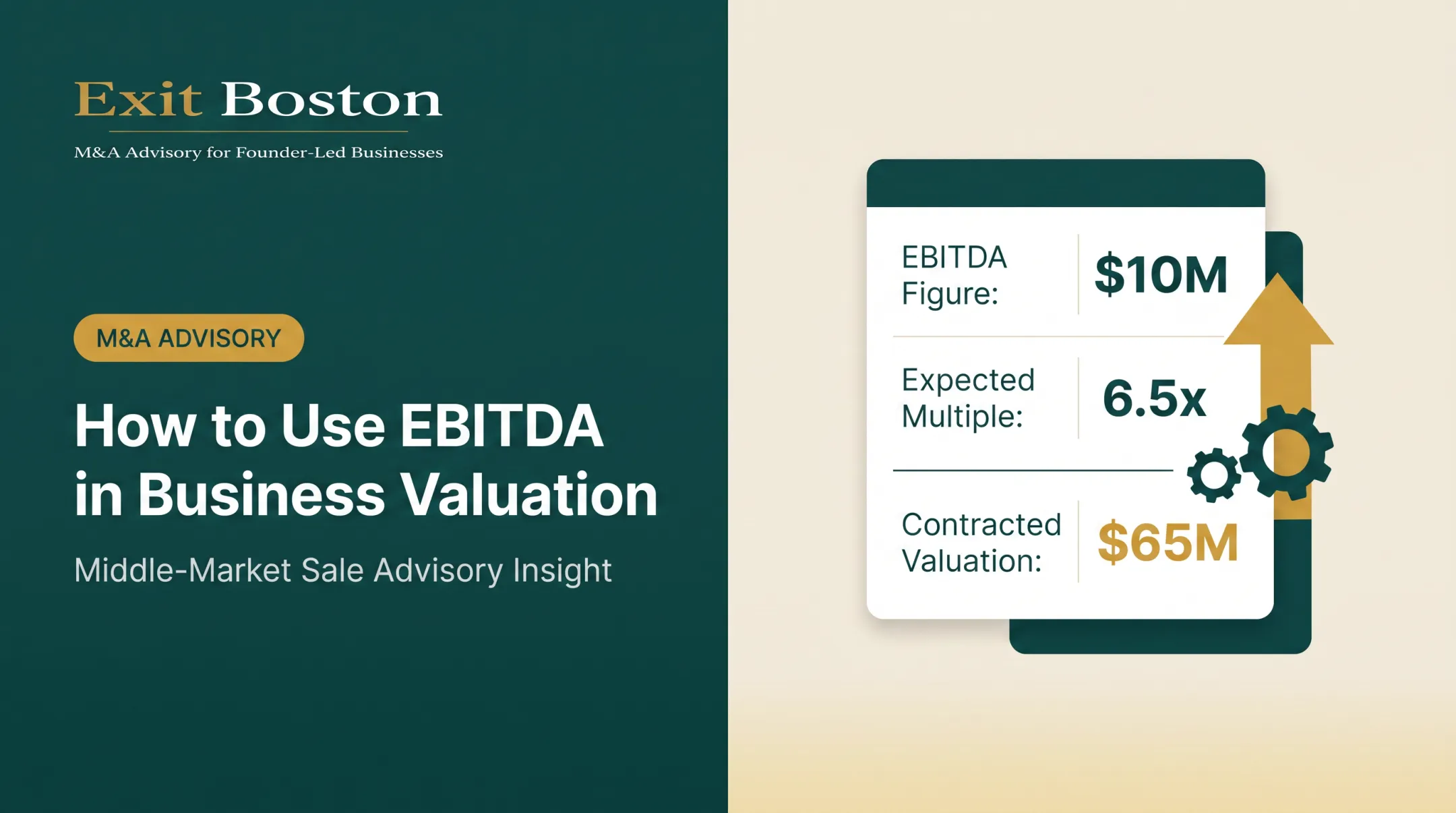
Adjusted EBITDA is the anchor metric. It represents sustainable operating earnings after stripping out owner compensation quirks, one-time expenses, and non-operating items. Buyers will challenge every add-back you propose, and the EBITDA they're willing to underwrite is rarely identical to the number on your P&L.
Other metrics that matter:
- Revenue growth: signals scalability and market share expansion, which drives buyer appetite even when current margins are modest
- Free cash flow: determines debt capacity in leveraged buyouts, where the buyer finances part of the purchase price
- EV/EBITDA multiple: the shorthand PE firms use to communicate and compare deals across companies of different sizes
How Quality of Earnings Shapes the Multiple
A quality of earnings (QoE) review tests whether your reported EBITDA is repeatable and defensible. This diligence process can raise or cut the multiple buyers will underwrite.
Case in point: a regional label manufacturer struggled to exceed 4.8x EBITDA because buyers saw founder dependence and weak management incentives baked into the numbers.
After six months of work on those gaps, the same company sold at 6.4x. Four and a half years later, under private equity ownership, the platform resold at 8.2x. Same business, three different multiples, driven by earnings quality and risk rather than by the industry.

Core Valuation Methods PE Firms Use
PE firms rarely rely on one method. They triangulate across several to arrive at a defensible number.
- Discounted Cash Flow (DCF): projects future cash flows and discounts them to present value. Works best for businesses with predictable, contracted revenue streams.
- Comparable Company Analysis (Comps): benchmarks your business against similar public or private companies using EV/EBITDA and EV/Revenue multiples.
- Precedent Transactions: looks at recent M&A deals in your sector to inform what buyers have actually paid, not just what they say they'd pay.
- Asset-based cross-check: occasionally used where tangible assets or liquidation value matter, though rarely the primary method for a healthy going concern.
On real market data, GF Data tracks private M&A transactions from $10 million to $500 million submitted by more than 300 PE firms. It reported that the average purchase price for PE-sponsored middle-market deals hit 7.5x trailing-12-month adjusted EBITDA in Q3 2025, up from 6.9x the prior quarter.

That's a meaningful jump in just one quarter, and it reflects overall deal mix rather than any single sector.
Sector-specific multiples for manufacturing, distribution, or food and beverage vary too much by company size, margin profile, and customer mix to quote a single number responsibly. Anyone who hands you a flat "manufacturers sell for X times EBITDA" figure is oversimplifying. A proper comparable-transaction pull, matched to your specific NAICS code and deal size, is the only credible way to ground that number.
The Calculation That Sets the Number
Every method above produces a candidate number. None of them decides the price. A PE buyer chooses the price that clears its own required return, and that return has exactly two sources: EBITDA growth and multiple expansion.
The illustration used in Exit Boston's own transaction material runs like this. Acquire a business at $4 million of EBITDA and a 6x multiple, so a $24 million purchase price. Grow EBITDA to $8 million over the hold and exit at 8x, and enterprise value is $64 million. Both levers pulled at once.
Leverage then amplifies whatever the levers produced. Fund the same $24 million with $12 million of equity and $12 million of debt, pay the debt down to $8 million across the hold, and a $64 million exit leaves $56 million of equity value against $12 million invested. That is nearly a 5x return on invested capital, roughly 35% a year.
Run that arithmetic backwards and you have your price. The buyer starts from the return it has to deliver, works back through the exit multiple it believes it can achieve and the EBITDA it believes it can build, and what remains is what it can afford to pay you today.
Which is why a credible, evidenced growth plan and clean, defensible earnings do more for your price than any argument about your sector's average multiple. You are not negotiating a multiple. You are negotiating the assumptions inside someone else's return model.
Factors That Influence Your Company's Valuation
The multiple you get is really a summary of how much risk the buyer sees. Here's what moves the needle most.
Founder/owner dependency. Can the business run, meaning sell, price, hire and solve customer problems, without you? If not, buyers discount the price, require an earnout, or ask for extended transition support. This is one of the biggest and most fixable discounts on the table.
Customer concentration. A business where one customer represents a large share of revenue carries real renewal risk. Buyers respond by reducing the multiple or building in protective deal terms, even when historical EBITDA looks strong.
The flip side matters just as much. Buyers pay premiums for businesses that reduce those risks:
- Recurring or contracted revenue over one-off project work
- A management team that operates independently of the founder
- Documented processes, SOPs, and systems that make the business transferable
- Diversified customer and supplier relationships
Market conditions matter too. Interest rates, sector-specific buyer demand, and the broader M&A environment all shift multiples over time, independent of anything happening inside your company. That's part of why timing your prep work matters as much as the prep itself.

How Sell-Side Advisory Helps Maximize Your Valuation
Negotiating with a single buyer almost never produces your best price. Creating competitive tension among multiple qualified buyers is one of the most reliable ways to drive a premium outcome.
Data from the IBBA/M&A Source Market Pulse survey found that among lower middle-market deals over $5 million, 87% of sellers who ran a proper process attracted at least three offers, and 33% attracted ten or more bids.
A well-prepared Confidential Information Memorandum and buyer-specific Investment Summary matter here too. These documents present your business in an institutional light, tailored to what each buyer type cares about:
- Growth thesis
- Revenue quality
- Margin structure
- Management depth
At Exit Boston, we pair CPA-led valuation work with operational insight from former C-suite executives. Co-founder Steve Vesey has prepared business valuations for over 25 years. Partner Sevan Demirdogen spent 40+ years running industrial businesses.
That combination surfaces value gaps before a business goes to market, not after a buyer finds them in diligence:
- Founder dependency
- Weak incentives
- Thin management bench
The label manufacturer mentioned earlier is a good illustration. After addressing founder dependency and building an independent management structure, the company sold its initial majority stake at 6.4x EBITDA. Over 4.5 years and three bolt-on acquisitions, EBITDA grew from $3.4 million to $9.0 million, and the multiple expanded to 8.2x, producing roughly $32.2 million in total founder proceeds.

We work specifically with founders generating $10 million to $100 million in revenue and $2 million to $10 million in EBITDA, across manufacturing, distribution, and food and beverage.
Frequently Asked Questions
What is private equity valuation?
Private equity valuation estimates what a PE firm would pay for your company based on sustainable cash flow, risk, and growth potential. The figure is transaction-specific and shifts with buyer fit and deal structure.
What is Big 4 valuation?
Big 4 valuation refers to services from Deloitte, PwC, EY, and KPMG, typically used for audits, tax reporting, or fairness opinions. It's not the same as a buyer's deal-specific M&A underwriting process.
How is EBITDA multiple determined for a private company?
EBITDA multiples depend on industry, company size, growth rate, and comparable transaction data. Buyer-specific factors like strategic fit and competitive tension also move the multiple.
Why do private companies get valued lower than public companies?
Private companies face illiquidity discounts, limited financial transparency, and often carry owner-dependency risk. Public companies also benefit from daily price discovery that private businesses simply don't have.
How often should a business get a valuation before considering a sale?
Get a baseline valuation several years before a planned exit so you can spot improvement opportunities early. The earlier you start, the more time you have to close value gaps.
What increases a company's valuation multiple the most?
Recurring revenue, a diversified customer base, and reduced owner dependency are consistently the top drivers. Buyers pay premiums for businesses that can run, and grow, without the founder in the room.