
In the middle market, deals involving leveraged businesses close every week. What matters is structure and preparation, not the mere presence of debt.
This guide covers how debt gets handled in a stock sale versus an asset sale, how it actually affects your valuation, and what you can do before going to market to keep it from becoming a negotiation headache. Founders of $10 million-$100 million revenue companies often carry debt as a normal part of scaling. It's rarely the disqualifier owners fear.
Key Takeaways
- You can sell a business with debt: most middle-market deals use a "cash-free, debt-free" structure
- Debt treatment depends on whether you're running a stock sale or an asset sale
- Buyers price deals off EBITDA and cash flow, not your capital structure
- An M&A advisor structures the deal to minimize friction over existing debt
- Senior debt in middle-market deals typically runs 2.0x to 3.0x EBITDA, which is the reference point buyers finance against
Can You Sell a Business With Debt?
Yes, and it's common. Selling with debt on the books doesn't disqualify a deal in the middle market. What changes is how proceeds get calculated at closing.
Most private M&A transactions use the "cash-free, debt-free" (CFDF) convention. This is a pricing mechanism, not a requirement that your company literally has zero debt or cash.
Here's how it works: buyer and seller agree on an enterprise value. At closing, that value gets adjusted upward for cash on hand and downward for outstanding debt. The seller keeps the cash; the debt gets paid off. Orrick describes CFDF as a term of art that separates headline price from actual closing mechanics.
Why doesn't debt scare off serious buyers? Because how a business was financed doesn't change how much cash flow it generates. A disciplined buyer values the business on EBITDA and cash-generating ability, not on whether that growth was funded with equity or a bank loan. This mirrors a core finance principle: capital structure and enterprise value are independent of each other.
At closing, mechanics are straightforward:
- Buyer wires the purchase price into escrow
- Lender gets paid first from proceeds (via a payoff letter)
- Remaining balance goes to the seller

One exception: in rare cases involving low-interest municipal financing or certain program loans, a buyer might assume the debt rather than pay it off, but only if the loan's change-of-control provisions allow it. This is the exception, not the rule.
How Debt Is Handled: Stock Sale vs. Asset Sale
The legal structure of your sale determines who inherits what liabilities.
Stock Sale
In a stock sale, the buyer acquires the entire legal entity: assets, contracts, and liabilities included. The buyer becomes the indirect owner of your existing debt because the company, and every obligation on its books, is what changes hands.
There are exceptions where the seller stays on the hook:
- Personally guaranteed liabilities tied to the seller, not the entity
- Debt the buyer requires paid off as a closing condition
- Obligations the seller explicitly agrees to retain post-close
Asset Sale
In an asset sale, buyer and seller negotiate exactly which assets and liabilities transfer. Debt typically stays with the seller unless the buyer specifically assumes it.
That shield is not absolute. Taft's analysis of successor liability notes that unknown or contingent claims, litigation or product-defect exposure for example, can still follow the buyer without careful drafting.
Asset sales are therefore more common when a seller has unresolved legal exposure or messy historical liabilities they do not want attached to the deal.

No single structure fits every transaction. Industry norms, buyer type, and tax posture drive the choice. Confirm the right path with your M&A advisor and tax counsel before you lock in either approach.
How Debt Impacts Business Valuation
Debt factors into the purchase-price bridge as a straight dollar-for-dollar deduction from enterprise value. But it doesn't typically get treated as a valuation penalty beyond that math.
Disciplined buyers, especially private equity, focus on EBITDA multiples. They're paying for cash flow. Debt reduces your take-home proceeds, but it usually doesn't reduce the multiple itself.
That said, heavy debt relative to cash flow can still create friction:
- Buyer hesitation around financing certainty
- Lower offers if lenders won't support the deal structure
- A smaller pool of buyers who can execute without heavy new leverage
GF Data's year-end 2025 report found the average purchase-price multiple sat at 7.2x trailing EBITDA, while full-year leverage stayed below historical norms. Sponsors leaned more on equity and deployed debt selectively.
Treat that as market context, not a formula. There's no universal debt-to-EBITDA cutoff that automatically shrinks your buyer pool.
The practical takeaway: cleaning up your balance sheet before going to market strengthens your negotiating position and can improve final proceeds, even if it doesn't change your headline multiple. Priority steps include:
- Paying down high-interest debt
- Resolving outstanding liens
- Tightening working capital

The Reference Point: Debt to EBITDA
There is no universal cutoff, and there is a reference point. Exit Boston's own transaction material puts senior bank debt in middle-market transactions at typically 2.0x to 3.0x EBITDA. That range is not a rule about your balance sheet. It describes what a lender will fund on the buyer's side of the table, and it matters to you for two reasons.
First, it tells you how your existing leverage reads. On $3 million of EBITDA, roughly $6 million to $9 million of senior debt sits inside market norms. Materially above that and a buyer is no longer just deducting your debt from the price. It is asking whether the business can carry any new debt at all, which narrows the field to buyers able to fund with equity, and equity is the expensive money in any capital stack.
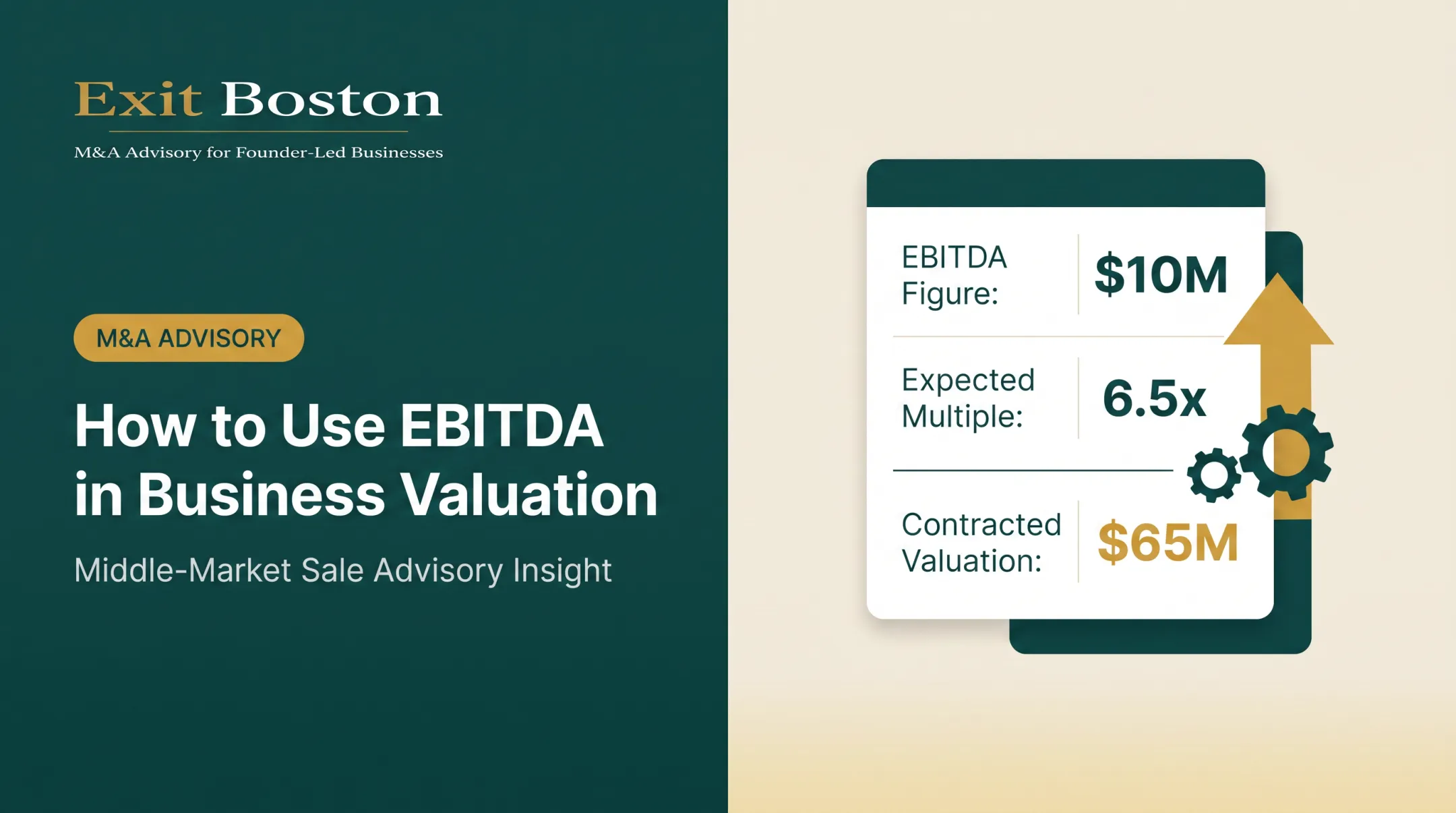
Second, it fixes the arithmetic on your proceeds. Equity value is enterprise value less net debt, and the gap can be larger than founders expect. Worked simply: $5 million of EBITDA at a 6x multiple gives a $30 million enterprise value, and $10 million of debt on the books leaves equity value at $20 million. Same business, a third of the headline gone before transaction costs.
So the point above holds. Debt does not usually cost you multiple. It costs you proceeds, and above the market range it starts costing you buyers as well.
Strategies for Managing Debt When Selling Your Business
You have real options for handling debt before you ever sit down with a buyer. Pay it off before the sale. Use available cash or a short-term bridge loan to present a cleaner balance sheet. This can simplify diligence and remove a negotiating variable entirely. Pay it off at closing. The most common route. Escrow deducts the payoff from proceeds and pays the lender directly, then releases the rest to you. On a $10 million sale with $2 million in debt, that means $2 million to the lender and $8 million to the seller. Negotiate buyer assumption. Typically limited to favorable, low-interest financing where the lender's documents actually permit assumption. Don't assume this is available. It requires lender sign-off and specific loan terms. Regardless of the route, treat these as non-negotiables:
- Full financial transparency going into negotiations
- Organized documentation on every liability, lease, and note
- Payoff letters and lien releases treated as closing conditions, not afterthoughts This is where working with an advisory team pays off. At Exit Boston, valuation specialists like Steve Vesey help founders understand true business value with debt properly accounted for, then structure terms so liabilities don't erode proceeds more than necessary. Getting the purchase-price bridge right (cash, debt, and debt-like items clearly defined) before you negotiate prevents surprises at the closing table.
When Debt Signals a Struggling Business
Not all debt is equal. There's a real difference between manageable operational debt and genuine insolvency.
Two tests help draw the line:
- Cash flow test: Can the business pay its debts as they come due?
- Balance sheet test: Do liabilities exceed the fair value of assets?

If your business fails either test, the sale process changes. Businesses facing genuine insolvency have more limited paths:
- Distressed sales
- Restructuring
- Chapter 11 or another court-supervised process
These situations bring creditor objections and far more intensive diligence than a standard sale.
If you suspect you're approaching this line, talk to qualified restructuring or legal advisors before you start marketing the business. Bringing a distressed company to market without addressing solvency first usually backfires. Buyers find out, and trust erodes fast.
Frequently Asked Questions
Is it possible to sell a business that has debt?
Yes. Most middle-market deals use a "cash-free, debt-free" pricing structure, where debt is paid off at closing from sale proceeds before the seller receives the balance.
How can I get my business out of debt?
Cutting costs, refinancing at better terms, and increasing cash flow are common paths. Many sellers also simply pay down debt using proceeds from the sale itself at closing.
Is it bad if a company has negative equity?
Negative equity means liabilities exceed assets on paper, which can complicate financing and buyer perception. It doesn't necessarily block a sale, since EBITDA-based valuation can still support a deal.
Do I have to pay my debt if it was sold to collections?
Yes, generally. Collection debt remains a legal obligation regardless of a business sale, unless it's specifically negotiated, settled, or assumed as part of the transaction terms.
Will Chapter 7 erase all my debts?
Not for a business entity. Chapter 7 liquidates company assets to pay creditors, but corporations and partnerships don't receive a discharge the way individuals do, so remaining debts do not disappear.
What is the best way to sell a business with significant debt?
Work with an experienced M&A advisor who can structure the deal properly, present your financials with full transparency, and target buyers positioned to handle your specific debt situation.