
Many owners rely on gut feel, a rumor about what a competitor sold for, or a rule of thumb from an industry conference. Institutional buyers don't work that way. Private equity firms, strategic acquirers, and family offices use rigorous, evidence-based methodologies to arrive at a number, and they'll defend that number in diligence.
There is also a step most owners miss. Before applying a multiple, a buyer sorts the company into a category, and the category sets the range it can come from. This guide covers the methods, the multiples, the factors that move them, and that sorting step.
Key Takeaways
- Middle-market businesses are typically valued using a multiple of EBITDA, not revenue or raw net income
- Income, market, and asset-based approaches should be triangulated, not used in isolation
- Customer concentration, management depth, and recurring revenue can swing multiples by several turns
- DIY valuations miss the adjustments buyers make in diligence, inflating seller expectations
- Buyers sort a company into a category before pricing it; founder-dependent operators cluster at 5x to 6x
What Is Business Valuation and Why It Matters for a Sale
Business valuation estimates what a company is worth to a buyer. That figure differs from book value, which reflects historical accounting, and from what an owner feels the business should be worth after years of sweat equity.
For a sale, valuation drives negotiation leverage, deal structure, and financing decisions on both sides of the table. A buyer's lender needs to underwrite the price. A seller needs a defensible number to anchor negotiations. Neither works from sentiment.
A sale valuation also differs from one prepared for tax, estate planning, or litigation. Those engagements answer different questions, for different users, under different standards. A valuation built for the IRS won't necessarily hold up when a private equity buyer's diligence team starts poking holes in it.
Who Actually Needs a Business Valuation
Valuation isn't just for owners actively marketing their company. Common triggers include:
- Preparing to sell within the next 12-36 months
- Exploring a recapitalization or partial liquidity event
- Succession planning or an internal ownership transfer
- Attracting outside investors or a private equity partner
- Benchmarking progress against long-term exit goals
The Three Core Approaches to Valuing a Business for Sale
Professional valuators generally rely on three approaches, and the most reliable valuations triangulate all three rather than leaning on one.
Income Approach
This converts expected future cash flow into a present value, typically through an EBITDA multiple or a discounted cash flow model. Multiples vary widely by sector. GF Data reported an average of 7.2x trailing-12-month adjusted EBITDA across 297 private-equity-sponsored deals completed in 2025. Axial's Winning LOI data shows Food and Hospitality businesses trading between 2.4x and 12x, with Industrials ranging from 2.3x to 8.2x.
Asset-Based Approach
This calculates tangible and intangible assets minus liabilities. It's most relevant for asset-heavy businesses, holding companies, or distressed situations where earnings power doesn't reflect true value.
Market-Based Approach
This compares the business to similar companies or precedent transactions. It's the closest thing to a real-world price check, but private middle-market data is harder to access than public company comparables. No single method tells the whole story. A business might look strong on an income basis but weak on assets, or vice versa. Exit Boston's advisory team includes CPA Steve Vesey, who has prepared business valuations for more than 25 years. The team triangulates all three approaches so founders understand their true market position before going to market, not after an offer falls apart in diligence.

How Many Times Profit Is a Business Worth
When people ask "how many times profit," they usually mean EBITDA, not net income. EBITDA strips out financing structure, taxes, and non-cash charges, so buyers can compare businesses on equal footing.
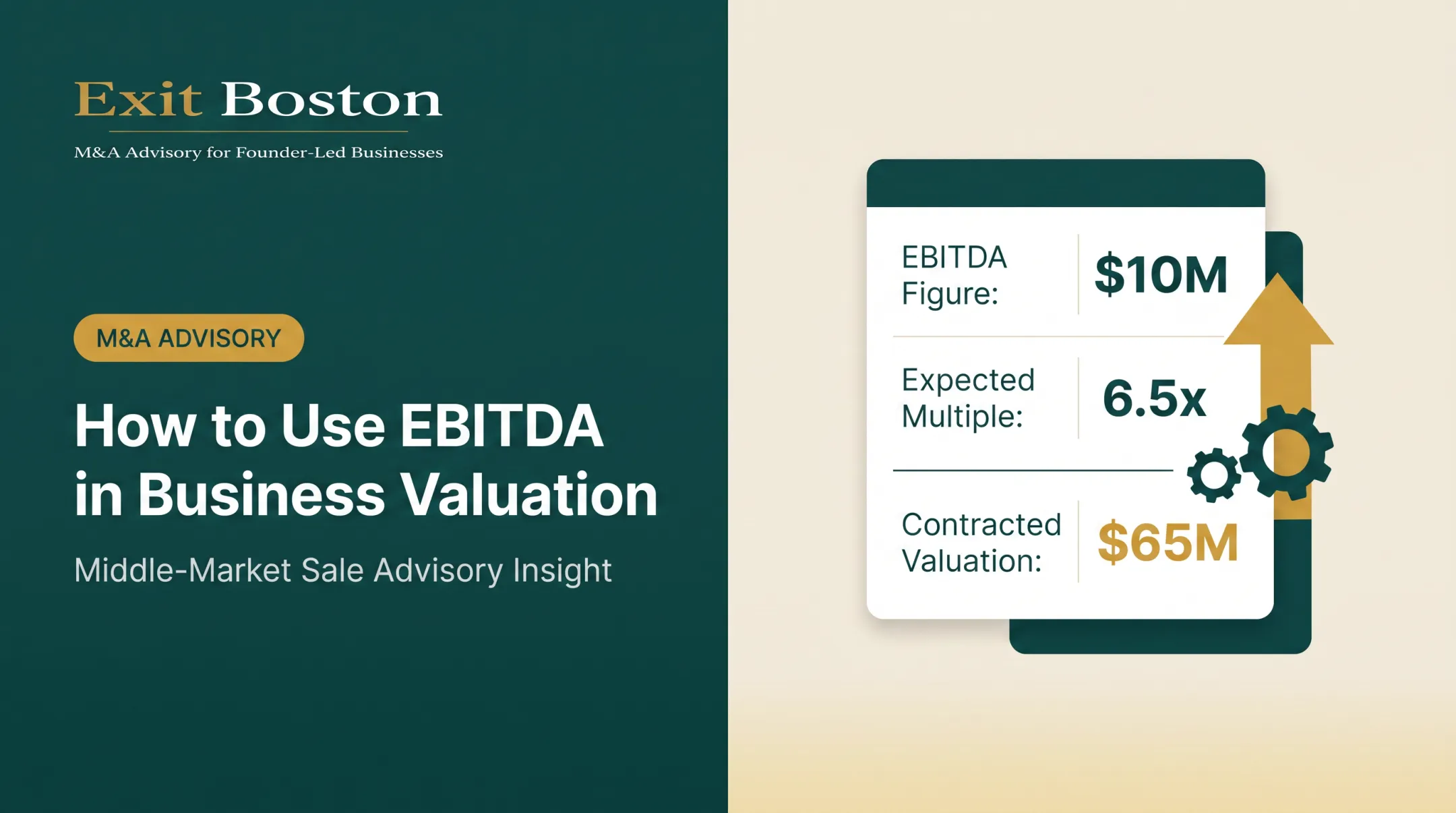
A simple example: A company with $4 million in EBITDA, valued at a 6x multiple, lands at a $24 million enterprise value. Move that multiple to 8x, and the same company is worth $32 million. That two-point gap, driven by risk and growth quality, is often worth more than any operational improvement a founder can make in a single year. Both figures are The Real Exit's own worked example.
What pushes a multiple higher or lower?
- Growth trajectory: Consistent double-digit growth earns a higher multiple than flat revenue
- Customer concentration: A diversified base commands a premium over reliance on a few large accounts
- Recurring revenue: Contracts and subscriptions lower perceived risk and support stronger multiples
- Management dependency: A business that runs without the founder is worth more than one that doesn't

Revenue multiples exist, but they're mainly used for very small businesses or specific models like SaaS, where recurring revenue is the actual economic unit. For most middle-market operating companies, buyers and their lenders underwrite to EBITDA multiples.
Key Factors That Move Your Valuation Up or Down
A handful of qualitative factors can move a valuation multiple by several turns, often more than an extra year of revenue growth:
- Founder dependency. If the business cannot run without the owner in the room, buyers cut the price or lock in a long, expensive earnout.
- Customer concentration. One account at 15-20% of revenue is real risk; it shrinks the buyer pool and the multiple.
- Management depth. Buyers pay for earnings that hold after the founder exits. A capable second layer signals the business is transferable.
- Predictability of earnings. Contracts, switching costs, and recurring revenue make future cash flow easier to underwrite, and support a higher multiple.
- Strategic fit and buyer competition. When the company fits several strategic acquirers, not only financial buyers, competitive tension usually drives a stronger price.
None of these show up on a balance sheet. Every serious buyer still scores them in diligence, and the score moves the multiple. The Real Exit states the same list from the buyer's side: growth potential, recurring revenue, management strength, market size, scalability, and reporting quality.

The Category a Buyer Puts You In Before They Price You
A multiple is not chosen from a table. It comes from a range, and the range depends on which kind of company the buyer decides they are looking at.
The Real Exit documents a New Hampshire aerospace machining business with roughly $8.5 million of EBITDA. Early indications clustered at about 6x, near $51 million. Nobody disputed the earnings. Buyers had put it in the founder-dependent operator category, "where multiples cluster around 5x to 6x", on four observations: decisions concentrated with the founder, thin management depth, reporting built for internal management rather than institutional review, and incentives loosely tied to growth.
The book is blunt: "Buyers weren't evaluating what Harrison had built. They were evaluating what would remain after he left."
The founder paused instead of accepting. The same $8.5 million later transacted at 7.2x, because the category had changed: formalised management roles, institutional-grade reporting, contracts giving forward revenue visibility, and a founder willing to roll equity.
Common Mistakes Business Owners Make When Valuing Their Company
Owners often weaken their negotiating position before a buyer ever sees the book. These three mistakes show up most often:
- Anchoring on emotional or anecdotal numbers. Hearing a competitor "sold for 10x" means little without deal structure, industry, or timing. Market data, not rumor, should set the range.
- Using financials that won't survive diligence. Non-standardized statements, miscalculated EBITDA add-backs, and unexplained one-time costs get picked apart quickly.
- Cherry-picking the highest number. Picking whichever method yields the biggest figure, instead of triangulating income, market, and asset approaches, creates a gap buyers will spot immediately and that kills momentum fast.
GF Data found sellers who ran a sell-side quality-of-earnings review averaged 7.4x TEV/EBITDA versus 7.0x without one, with the gap most pronounced above $50 million in enterprise value.

Why Working With an M&A Advisor Produces a More Accurate, Defensible Valuation
A credible valuation isn't just arithmetic. It requires market intelligence on buyer demand, precedent transactions, and industry-specific multiples that most owners simply don't have access to. Axial data in The Real Exit puts represented sellers 60% more likely to close, at 6% to 25% higher prices.
An advisor's role extends well beyond calculating a number. Work that directly affects final price includes:
- Strengthening positioning before the business goes to market
- Addressing founder dependency
- Tightening financial reporting
- Identifying the right buyer pool
Exit Boston pairs CPA-led valuation work with institutional buyer readiness. The firm builds buyer-specific investment summaries tailored to what a particular private equity firm, strategic acquirer, or family office is actually looking for.
That positioning work, backed by precedent transaction and buyer-universe research, has helped founder-led companies in the $10 million to $100 million revenue range exceed their initial expected valuation range. Documented examples include:
- A commercial label printing company that moved from an expected $8-10 million range to a $12 million sale
- An independent beer importer that went from an $18-20 million expectation to a $24 million contracted price
The pattern is the aerospace one: the earnings did not change between the first estimate and the final price. The category did.
Frequently Asked Questions
How much should a business valuation cost?
Costs vary widely based on business size and complexity. Many M&A advisory firms, including Exit Boston, bundle valuation work into broader exit-planning engagements rather than charging a standalone fee.
What is the formula for valuing a business to sell?
The general approach multiplies EBITDA by an industry-appropriate multiple. The "right" multiple depends on industry, company size, growth, and risk profile, so there's no universal formula that fits every business.
How do I value a company based on revenue?
Revenue multiples apply revenue times a sector-specific factor, but they're less reliable than EBITDA multiples for most middle-market sales because they ignore profitability and cost structure entirely.
How do I value a company for acquisition?
Acquirers typically triangulate income, market, and asset-based approaches, then adjust for expected synergies, integration costs, and strategic fit specific to that buyer.
What are the top 3 valuation methods?
The income approach (EBITDA multiple or discounted cash flow), the market approach (comparable companies and precedent transactions), and the asset-based approach (net assets minus liabilities).
What is a good revenue-to-valuation ratio?
"Good" ratios vary enormously by industry, so there's no universal benchmark. EBITDA-based multiples are generally far more meaningful for middle-market companies than revenue ratios.
Why do two companies with the same EBITDA sell for different prices?
Because buyers price the category, not the earnings alone. Founder-dependent operators cluster at 5x to 6x; the same earnings read as an institutional platform support more.