
Business valuation isn't just for founders heading toward a sale. It matters for raising capital, structuring partnerships, resolving shareholder disputes, and estate planning. Getting it wrong in any of these situations creates real financial consequences.
This guide breaks down the core valuation methods, how revenue and profit multiples actually work, common rules of thumb (and their limits), and when it's time to bring in a professional.
Key Takeaways
- Business value is calculated using income, market, and asset-based approaches, usually blended together
- Revenue and EBITDA multiples vary widely by industry, size, and growth trajectory
- Rules of thumb work for rough estimates but rarely hold up in a real negotiation
- Companies with $10M-$100M in revenue benefit most from professional valuation and buyer-readiness prep
- An accurate valuation is the starting point for negotiating a premium offer, not the ceiling
What Are the Main Types of Business Valuation Methods?
Three approaches dominate business valuation, and each answers a different question.
Income approach. Values a business on projected future earnings or cash flow, most often through discounted cash flow (DCF) analysis. It fits companies with a predictable, stable earnings history.
Market approach. Compares the business to recent sales of similar companies or comparable public companies. Buyers and sellers lean on it in negotiations because it reflects what someone actually paid in the real world.
Asset-based approach. Totals tangible and intangible assets, then subtracts liabilities. It fits asset-heavy businesses or companies that aren't generating strong cash flow.
Professional valuators rarely rely on just one method. The American Society of Appraisers' business valuation standards state that a conclusion may rest on one or more methods across one or more approaches, with weighting based on professional judgment and data quality, not a fixed formula.
| Business Type | Best-Fit Method |
|---|---|
| Manufacturing (asset-heavy) | Asset-based, cross-checked with market |
| Service businesses | Income or market approach |
| Tech / recurring revenue | Income approach (DCF), market comps |
| Distribution / logistics | Market approach with asset backup |

Steve Vesey, Exit Boston's co-founder, has spent more than 25 years preparing business valuations and has guided hundreds of owners through succession planning. That repetition builds judgment no single formula can replace. You still need context on how a specific industry actually trades.
How Do You Calculate the Selling Price of a Business Using Multiples?
Multiples are the fastest way to turn financials into a price range. Two shortcuts dominate most estimates:
Revenue multiple: Revenue × Industry Multiple = Estimated Value
- Example: $8M revenue × 1.2x multiple = $9.6M estimated value
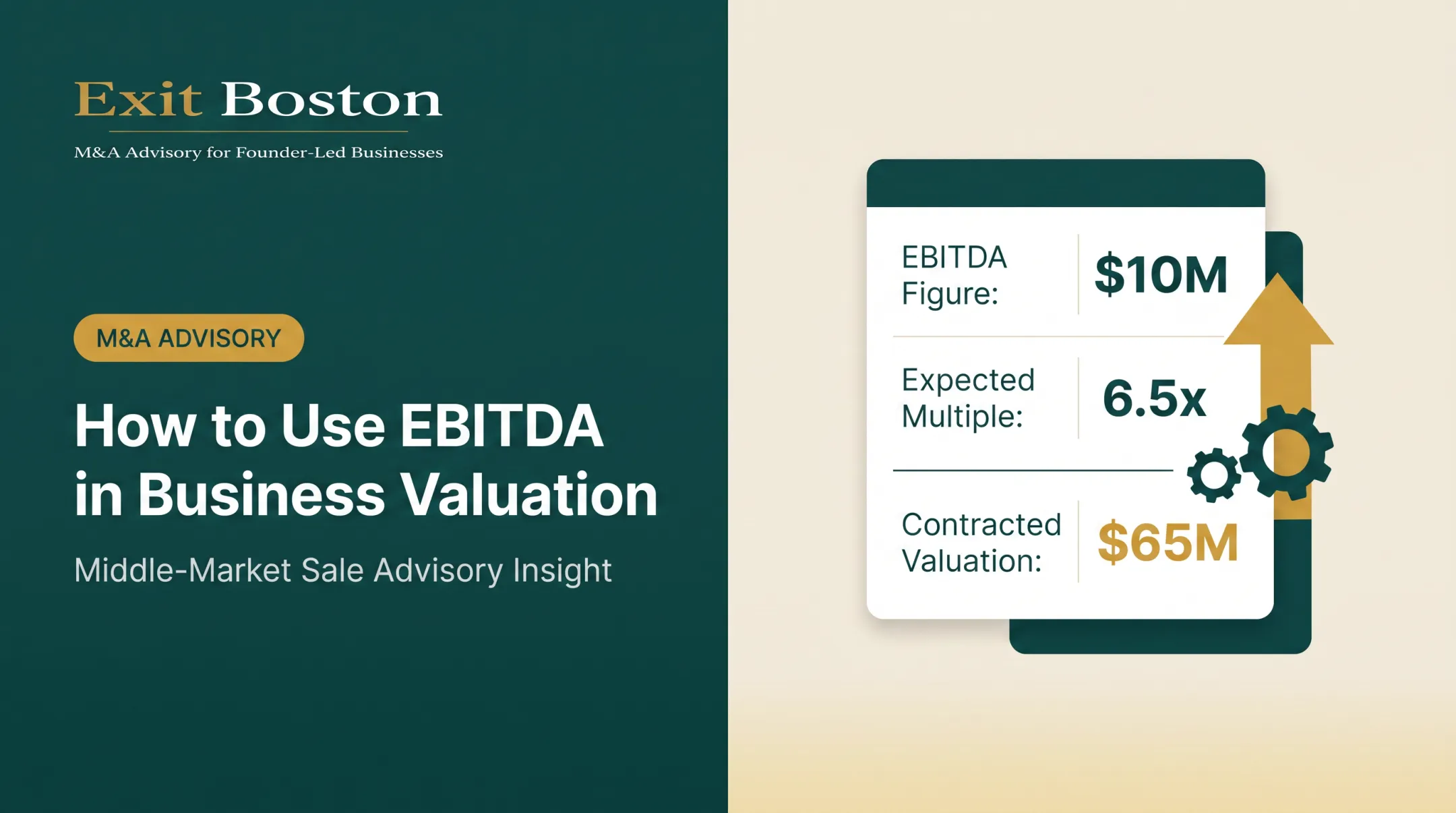
EBITDA multiple: EBITDA × Industry Multiple = Estimated Value
- Example: $3M EBITDA × 6x multiple = $18M estimated value
Revenue multiples give you a fast ballpark. EBITDA multiples are far more reliable because they account for actual profitability, not just top-line sales. Two companies with identical revenue can have wildly different values if one runs at a 25% margin and the other at 8%.
Here's the catch: your valuation and your final selling price are rarely the same number.
Selling price is shaped by:
- Strategic fit with a particular buyer
- Competitive bidding among multiple parties
- Negotiation leverage and timing
- How badly the buyer wants that specific customer base, team, or market position
One thing multiples do not tell you: enterprise value is not proceeds. The Real Exit works the bridge as enterprise value less net debt. A $20.4M enterprise value carrying $5M of debt and $1M of cash leaves $16.4M of equity value, before transaction costs and any rollover equity. Two companies with identical EBITDA can write very different checks to their owners.
A single buyer has no reason to pay above baseline valuation. Multiple qualified buyers competing for the same asset changes the entire dynamic.
A structured process is what creates that competition. Exit Boston builds buyer-specific Investment Summaries tailored to each acquirer's stated criteria, then runs a competitive bidding process instead of a single-buyer negotiation. The results show up in the numbers:
- A municipal water drilling company with $2.1M EBITDA was expected to fetch $10.0M-$11.5M. It closed at $12.9M, about 6.1x EBITDA.
- A commercial label printer expected $8.0M-$10.0M closed at $12.0M, roughly 6.0x EBITDA.
- An independent beer importer expected $18.0M-$20.0M closed at $24.0M, about 7.1x EBITDA.
Across recent deals, outcomes have exceeded initial expected ranges by roughly 20% or more on average.

How Many Times Revenue or Profit Is a Business Typically Worth?
Multiples vary sharply by sector, size, and deal quality. Typical ranges:
Revenue multiples tend to be lower for service businesses (often under 1x) and higher for tech or recurring-revenue models, where predictable income commands a premium.
EBITDA multiples generally scale with company size:
- Small businesses: 2x-4x EBITDA
- Middle-market companies: 4x-6x, with variation by sector
Broader market data shows the same pattern at scale. According to GF Data's Q3 2025 report, average purchase-price multiples for PE-sponsored deals reached 7.5x TTM adjusted EBITDA, up from 6.9x the prior quarter.
Exit Boston works across several sectors where these dynamics play out differently:
- Distribution and logistics: asset intensity and customer contracts shape multiples
- Building products: cyclical demand affects buyer appetite
- Specialty chemicals: regulatory complexity and formulation IP can support higher multiples
- Manufacturing and EMS: scalability and customer diversification drive premiums
- Specialty plastics / food & beverage: brand strength and channel relationships matter heavily
What consistently pushes multiples higher, regardless of sector:
- Recurring or contracted revenue
- A diversified customer base with no single account over 10-15% of sales
- A management team that operates independently of the founder
The label company case in The Real Exit shows how this plays out, and it happens in two distinct stages that are easy to run together.
Stage one is preparation, and it belongs to the founder. Early market feedback capped the business below 4.8x EBITDA because of founder dependency and loosely structured management incentives. Roughly six months later, with a management structure that could operate independently and a jointly funded management incentive program in place, it sold at 6.4x on $3.4M of EBITDA: an enterprise value of $21.76M against the founder's initial expectation of about $16M.
Stage two belongs to the private equity owner. Over the following 4.5 years, three regional label manufacturers were acquired, EBITDA grew from $3.4M to $9.0M, and the platform exited at 8.2x for $73.8M. Because the founder had rolled 20% of his proceeds, his share of that second sale was worth $14.76M, taking his total outcome to $32.17M.
Preparation earned the first 1.6 turns. Scale earned the next 1.8. They are not the same lever and a seller should not expect the second one before closing.

Common Rules of Thumb for Valuing a Small Business
Rules of thumb exist because they're fast. "2-3x annual profit" for a service business, or a percentage of revenue for a retail operation, these give owners a starting point without hiring anyone.
The problem: they ignore everything that actually determines value.
A rule of thumb can't account for:
- Customer concentration (one client at 40% of revenue is a red flag that no formula captures)
- Growth rate and trajectory
- Asset quality and condition
- Management depth beyond the owner
The National Association of Certified Valuators and Appraisers treats rules of thumb as reasonableness checks only, not standalone valuation methods. The IRS takes a similar stance in Revenue Ruling 59-60, noting that no single formula applies to every valuation situation.
Use rules of thumb to get a rough sense of where you stand. Don't use them to negotiate with a serious buyer or an institutional acquirer. They'll have done real diligence on concentration, earnings quality, and owner dependence, and a rule-of-thumb number won't hold up.
Key Value Drivers That Increase or Decrease Business Value
Buyers pay premiums for businesses that feel safe to own. That safety comes from specific, identifiable factors.
What increases value:
- Reduced owner dependency so the business runs without you every day
- Recurring revenue and long-term contracts
- A diversified customer base
- Clean, well-documented financials
- A management team with real depth beyond the founder
What decreases value:
- Customer concentration in one or two accounts
- Inconsistent or poorly documented financials
- Weak management bench strength
- Heavy reliance on the founder's personal relationships
How buyers price these drivers
Accounting firm KMCO notes the same pattern: predictable recurring revenue typically commands higher multiples, while dependence on a few customers pulls the multiple down.
The label company case showed the upside in practice. The founder moved into a strategic role, agreed to a two-year transition under a management agreement, and jointly funded a management incentive program with the buyer. Transition risk fell, and the multiple went from below 4.8x to 6.4x.
Positioning the company as institutional-quality, with clean books, scalable operations and a real second-line team, helps founder-led businesses compete for offers from private equity firms, strategic acquirers, and family offices instead of relying on a single bilateral bid.

When to Get a Professional Valuation and Work With an M&A Advisor
Certain situations call for more than a spreadsheet estimate:
- Preparing for a sale: buyers will do their own diligence; you need a number that survives scrutiny
- Raising capital: investors want a defensible valuation, not a guess
- Partnership disputes: buyouts and ownership changes require impartial numbers
- Tax and estate planning: the IRS uses a willing-buyer, willing-seller standard under Revenue Ruling 59-60; gift tax filings need fair market value on the transfer date
A professional valuator or M&A advisor looks beyond the formula. They evaluate buyer psychology, deal structuring, market timing, and how a specific business will read to a specific type of acquirer: private equity, strategic buyer, or family office.
The measured difference is large. Companies that work with professional M&A advisors are 60% more likely to complete a successful sale, and advisor-represented transactions produce purchase prices 6% to 25% higher than unrepresented sales of comparable businesses. Those figures come from Axial, the private deal network that connects middle-market advisors with institutional buyers.
Exit Boston works with founders of $10M to $100M revenue companies. The firm's process starts with a confidential consultation covering how the business looks through an institutional lens, what buyers in that situation seek, and a roadmap for strengthening the company before it goes to market.
For deeper readiness work, the firm applies the Seven Pillars, the diagnostic it runs on every engagement. All seven, with the buyer's question behind each:
- Owner Independence: what breaks if the owner steps away?
- Management Depth: who is actually running this business post-close?
- Financial Clarity: can we trust the numbers, and can we model the future?
- Margin Quality: are margins sustainable, or are we buying risk?
- Recurring Revenue: how much of next year's revenue is already visible?
- Operating Infrastructure: will this business scale, or break under growth?
- Growth Pathways: where do we put capital, and what does that return?
That advisory focus has earned independent recognition. In the Q2 2024 Axial League Table, Exit Boston was ranked the number one M&A advisory firm in Massachusetts, the number two firm in New England, and among the top ten in the United States. The League Table is built from platform transaction data across thousands of active advisory firms rather than from self-reported credentials.
Frequently Asked Questions
How much is a business worth based on annual sales or profit?
Apply an industry-appropriate multiple to revenue or profit, then adjust for risk factors like customer concentration and management depth. Two businesses with identical sales can have very different values.
How do you calculate the selling price of a business?
Multiply revenue or EBITDA by an industry-appropriate multiple to get a baseline estimate. The actual selling price often lands higher, shaped by buyer competition and negotiation leverage.
How many times revenue is a business typically worth?
Revenue multiples typically range from under 1x for service businesses to about 2x-5x+ for recurring-revenue or tech companies. The range varies significantly by industry and growth profile.
How many times profit is a business typically worth?
Small businesses often sell for 2x-4x EBITDA, while middle-market companies see 4x-7.5x depending on sector and deal quality, per recent GF Data reporting on private-equity transactions.
What are the main types of business valuation methods?
The three core approaches are income (based on future cash flow), market (comparing recent sales of similar businesses), and asset-based (tangible and intangible assets minus liabilities). Professionals typically blend them.
How do you value a small business?
Small businesses often use simplified multiples or seller's discretionary earnings (SDE) rather than the full EBITDA-based institutional methods used for larger, middle-market companies.