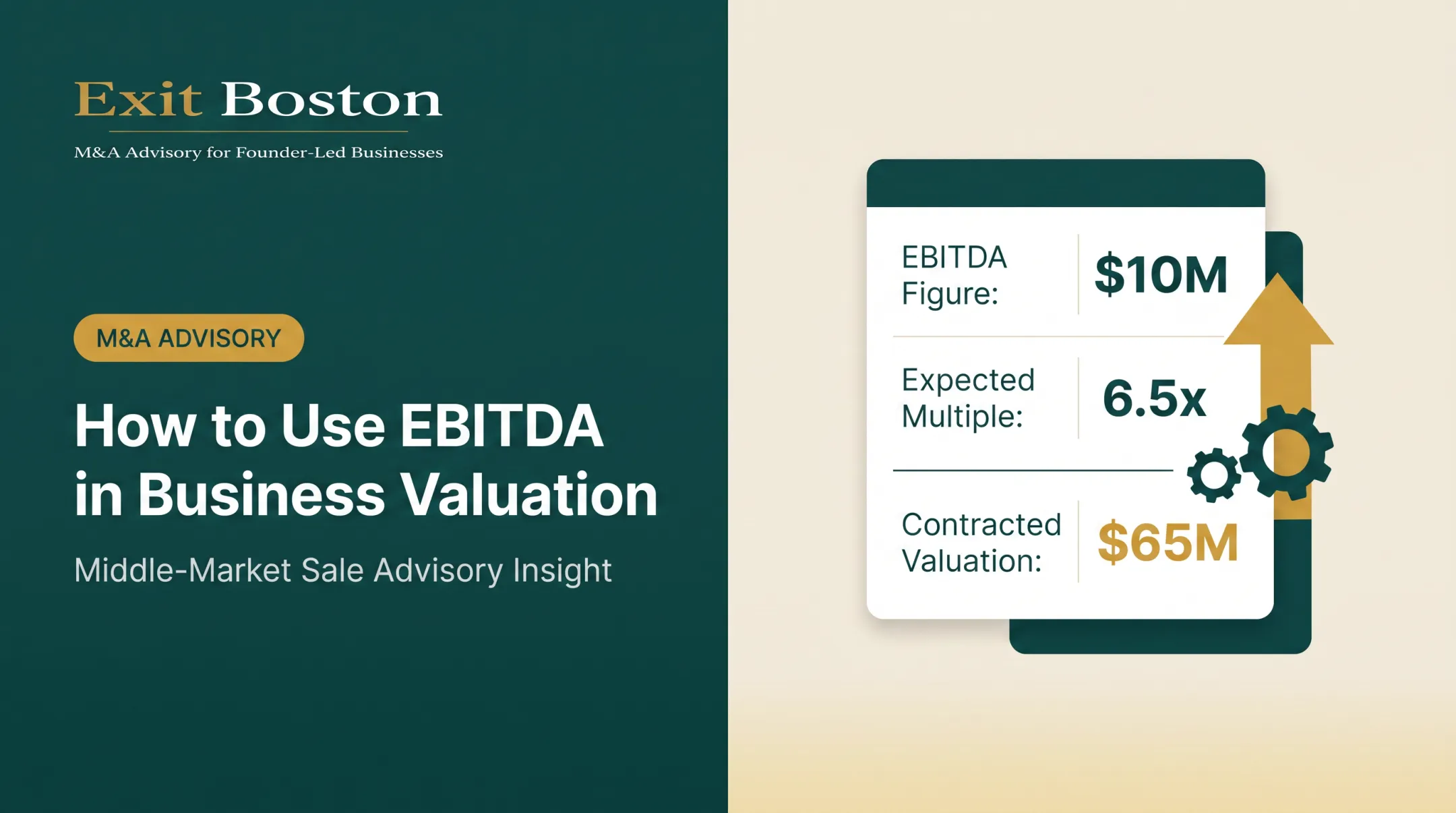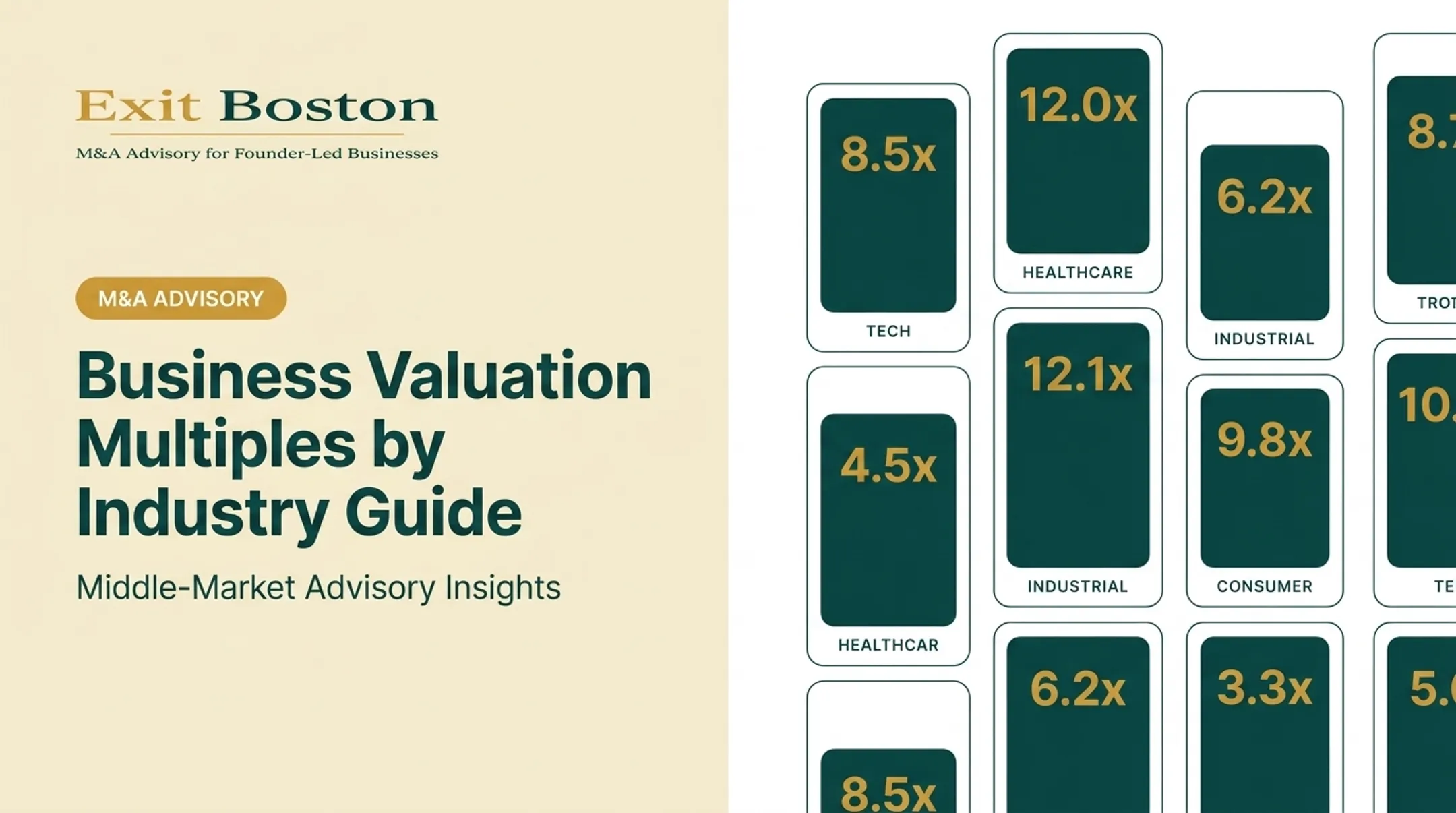

Revenue multiple valuation is a market-approach method that prices a business by multiplying its revenue by an industry-derived factor. It's distinct from EBITDA-based approaches, which price a business on profitability rather than top-line sales. Both matter. Knowing which one governs your negotiation matters more.
This guide covers how to calculate a revenue multiple, what's typical by industry, how revenue multiples compare to EBITDA multiples, and when each method should actually drive your number.
Key Takeaways
- Revenue multiple valuation divides enterprise value by annual revenue and works even for pre-profit companies.
- Multiples vary widely by industry: sub-1x for distribution and manufacturing, 4x-10x+ for high-margin SaaS.
- Treat revenue multiples as a starting point, not a substitute for EBITDA-based valuation once a company is profitable.
- For established middle-market companies, EBITDA multiples typically produce a more accurate, defensible value.
What Is Revenue Multiple Valuation?
Revenue multiple valuation estimates a company's worth as a multiple of its sales. The core formula is EV/Revenue = Enterprise Value ÷ Annual Revenue. It falls under the market approach: appraisers pull comparable transactions from private deal databases and apply the resulting multiple to the subject company's revenue.
Here's where people get tripped up: EV/Revenue is not the same as Price-to-Sales. EV/Revenue uses enterprise value in the numerator (equity value plus debt, minus cash). Price-to-Sales often uses a raw selling price or equity value instead. Mixing the two produces a number that looks precise but isn't comparable to anything.
Which Revenue Figure Are You Using?
Three inputs show up in practice, and they're not interchangeable:
- TTM (trailing twelve months): standard for stable, established businesses
- NTM (next twelve months): used for high-growth companies with a credible forecast
- ARR (annual recurring revenue): used for subscription businesses with predictable, recurring income
Mixing these bases in one comp set is a common source of valuation error.
Who relies on this method in practice? Growth-stage and SaaS companies, pre-profit businesses without meaningful EBITDA, and strategic acquirers buying for market share rather than earnings.
Why It Matters for Middle-Market Sellers
Most companies in the $10M-$100M revenue range that Exit Boston works with are already profitable. For this group, revenue multiples usually function as a secondary reference point, a sanity check, rather than the primary valuation driver. Buyers evaluating a profitable manufacturer or distributor want to know what it earns, not just what it sells.
How to Calculate a Revenue Multiple
The process follows four steps:
- Identify comparable sold companies: same industry, similar size, recent transaction dates, and similar geography
- Calculate EV/Revenue for each comparable transaction
- Find the median across the comp set (not the average; outliers skew averages)
- Apply that multiple to the subject company's revenue

Worked example: Say a distribution company generates $20 million in TTM revenue, and the median comp multiple is 0.9x. That implies an enterprise value of $18 million. From there, add cash and subtract debt to bridge to equity value: the number the seller actually walks away with.
Why Filtering Matters More Than the Multiple Itself
DealStats is one of the primary transaction databases appraisers use. A deal only qualifies as a comparable if it has a disclosed sale date and price, a full 12 months of actual (not pro forma) operations, and a confirmed 100% ownership transfer.
It also filters by NAICS code, deal size, and transaction structure.
Pulling an unfiltered "industry average" off a table and applying it to your business is one of the most common valuation mistakes. Two distributors with identical revenue but different geography, customer concentration, or deal structure shouldn't get the same multiple.
Gross margin is the biggest lever within an industry. Two companies with identical $20 million revenue can justify very different multiples if one runs a 15% gross margin and the other runs 35%.
Margin is not the only lever, and the rest are not financial. The Real Exit lists what institutional investors actually weigh when they set a multiple: growth potential, recurring revenue, management strength beyond the founder, the size of the addressable market, scalability, and the quality of financial reporting. A revenue multiple pulled from a comp table prices none of those. It prices the industry the company happens to sit in.
The math is straightforward: at a fixed 1.0x EV/Revenue, a 10% EBITDA margin implies a 10x EV/EBITDA multiple, while a 20% margin implies just 5x. Same revenue, very different underlying value.
Revenue Multiples by Industry: What's a Good Multiple?
"Good" is relative. Here's a directional range by sector:
| Industry | Typical EV/Revenue Range |
|---|---|
| Distribution & logistics | 0.6x - 1.9x |
| Building products | Under 1x |
| Specialty chemicals/manufacturing | 0.5x - 1x |
| Electronic manufacturing services | Under 1x (contract manufacturers) |
| Specialty plastics | Under 1x |
| Food & beverage / CPG | 2x - 4x+ |
| Professional services | 3.2x - 3.6x |
| SaaS | 3x - 7x+ |

Sources: distribution/logistics figures reflect PCE Investment Bankers' 2026 transportation and logistics M&A update; professional services figures reflect Lincoln International's Q2 2026 market data. Other rows are directional market ranges, not formal appraisals.
Within any industry, three factors push a company toward the top of its range:
- Recurring or contracted revenue that buyers can underwrite with confidence
- Low customer concentration, so one account cannot reprice the deal
- Strong, defensible gross margins that hold up in diligence
For middle-market companies roughly in the $10M-$100M revenue band, placement inside these ranges usually hinges on growth trajectory, customer quality, and buyer fit, not the industry label alone.
Treat this table as a starting point for a conversation, not a number to plug into a spreadsheet and call it final. A formal valuation grounded in real, filtered comparable transactions will always beat a rule-of-thumb range.
Revenue Multiple vs. EBITDA Multiple: Which Should You Use?
Revenue multiples ignore profitability entirely. EBITDA multiples price a business on its actual cash-generating capacity. That distinction drives how deals get priced.
| Factor | Revenue Multiple | EBITDA Multiple |
|---|---|---|
| Input | Annual revenue | Normalized EBITDA |
| Best use case | Pre-profit, high-growth, SaaS | Profitable, stable middle-market companies |
| What it ignores | Margin, cost structure, cash flow | Add-back adjustments (not profitability itself) |
| Typical range | 0.5x - 10x+ (industry dependent) | 3x - 8x+ (industry dependent) |

Buyers generally prefer EBITDA multiples because they are pricing cash flow, not revenue alone. Sellers of high-growth or thin-margin businesses often prefer revenue multiples, which can imply a higher value when margins are weak or nonexistent.
For profitable, established middle-market companies, the profile Exit Boston advises most often, EBITDA multiples are the industry standard. Institutional buyers, private equity firms, and strategic acquirers negotiate around them at the table.
The spread on that basis is what a revenue multiple conceals. In New England metal fabrication, Exit Boston's own observed and transacted ranges for 2024 through mid-2026 sit in three tiers on adjusted EBITDA:
| Tier | Observed range | What defines it |
|---|---|---|
| Exceptional | 8.0x to 9.0x | Deep qualified backlog, program-of-record revenue, automated production with documented throughput, margins meaningfully above sector norms |
| Solid mid-market | 4.5x to 6.0x | Well run and profitable, good customers, manual or semi-automated production, margins at sector norms |
| Behind the curve | 4.0x to 4.5x | Below capacity on aging equipment, compressed margins, quality managed by inspection rather than prevention |
Those are observed transaction ranges, not an appraisal. The point is the width: on $3 million of adjusted EBITDA, the distance between the middle tier and the top one is roughly $9 million of enterprise value. No revenue multiple in the sub-1x band distinguishes between those three companies, because their revenue looks the same.
An experienced M&A advisor helps you apply both methods in context:
- Evaluate the business under revenue and EBITDA frameworks
- Identify which multiple will govern a given negotiation
- Build competitive tension so buyers cannot default to the weaker frame
That pattern recognition matters when a buyer opens with a lowball revenue-based number on a company that clearly deserves EBITDA-based pricing. Across 50 to 100 closed middle-market transactions, Exit Boston has seen how often the framing fight decides the outcome as much as the multiple itself.
Limitations of Revenue Multiple Valuation
Revenue multiples break down in specific, predictable situations:
- Capital-intensive businesses: heavy equipment or infrastructure needs distort what revenue actually represents
- Declining-revenue companies: a shrinking top line with a static multiple overstates value
- Stable, profitable companies with reliable EBITDA: a more precise method is already available
Two businesses with identical revenue but different margins can carry a two-to-three-times difference in true value, a gap that a revenue multiple alone simply cannot capture. A distributor at 8% margin and one at 22% margin might both show $15 million in revenue, but they are not the same business to a buyer.
Owners preparing for a sale should get a professional valuation that combines market, income, and comparable-transaction approaches rather than relying on a rule-of-thumb multiple pulled from an industry table.
Frequently Asked Questions
What is revenue multiple valuation?
Revenue multiple valuation is a market approach that prices a business by multiplying its revenue by an industry-derived factor (EV/Revenue), independent of profitability. It is most useful for pre-profit or high-growth companies.
How do you calculate a revenue multiple?
Identify comparable transactions, divide each one's enterprise value by its revenue, take the median, then apply that multiple to your company's revenue. Adjust for cash and debt to reach equity value.
What is a good revenue multiple for valuation?
It depends entirely on industry, margin, and growth. Manufacturing and distribution often fall under 1x, while high-margin SaaS businesses can command 4x to 10x or more.
What's the difference between a revenue multiple and an EBITDA multiple?
Revenue multiples ignore profitability; EBITDA multiples price cash-generating capacity. For profitable, established businesses, most middle-market companies, EBITDA multiples are the default standard.
How do gross margins affect a revenue multiple?
Margin is the primary driver of multiple variance within the same industry. Two companies with identical revenue but different margins can justify very different valuations.
When should a business owner get a professional valuation instead of relying on rule-of-thumb multiples?
Before entering a sale process, negotiating a partner buyout, or responding to an unsolicited offer. Exit Boston's team includes CPAs and advisors experienced in preparing defensible valuations for founder-led companies.