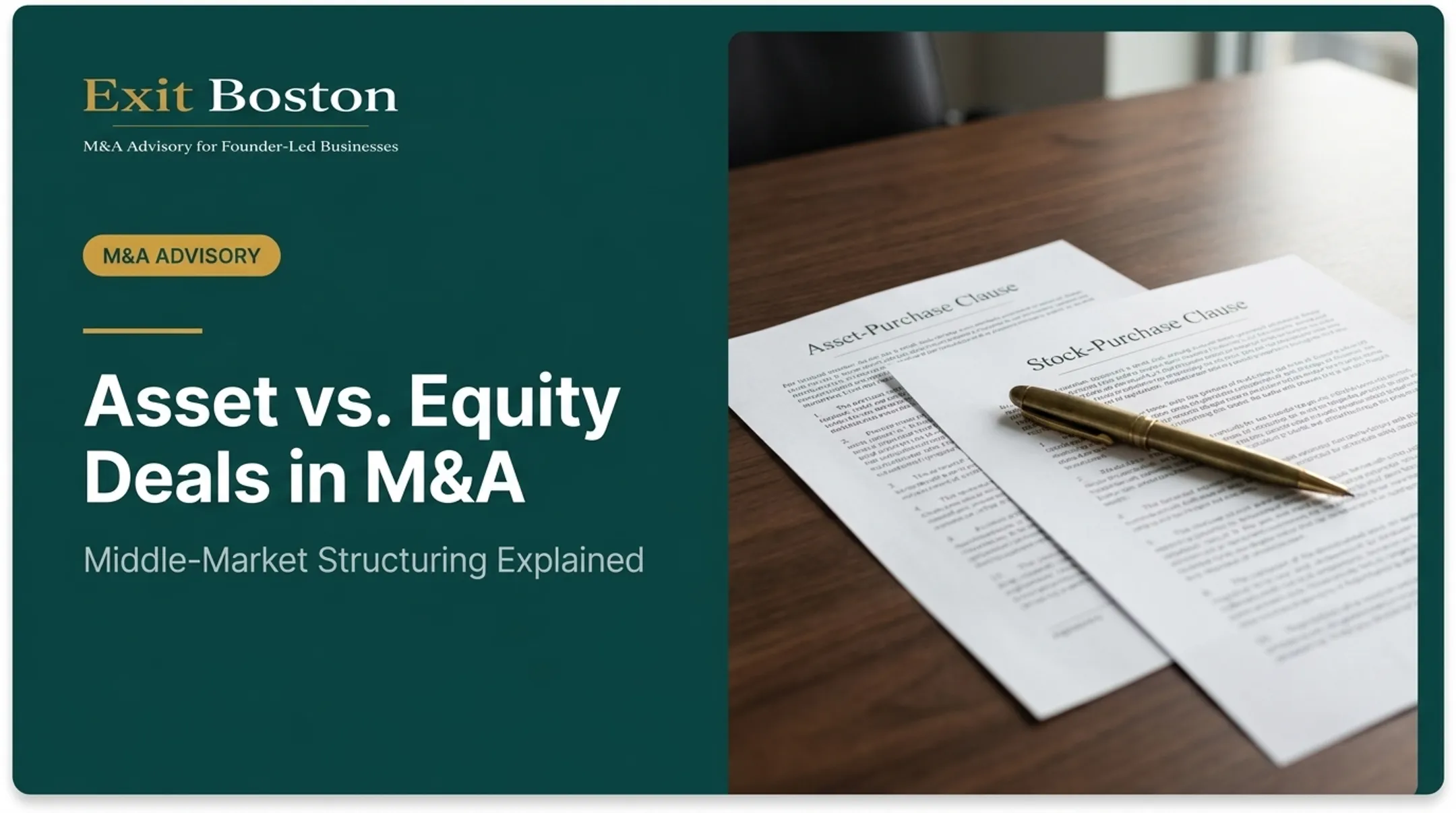

Founders running $10M-$100M revenue businesses are increasingly courted by private equity firms and strategic buyers, and these buyers often walk into negotiations with strong structural preferences already baked in. The deal structure they propose isn't just legal boilerplate. It can swing your net proceeds by hundreds of thousands of dollars and determine who's on the hook if a liability surfaces two years after closing.
This article breaks down what a share sale is, how it differs from an asset sale, and the tax and risk trade-offs both sides need to understand before anyone signs a letter of intent.
Key Takeaways
- Share sales transfer the whole legal entity, including assets, liabilities and contracts; asset sales transfer only selected assets
- Sellers get better capital gains treatment in share sales; buyers prefer asset sales for liability protection and a stepped-up tax basis
- The right structure depends on buyer type, deal size, industry, and your personal tax and legacy goals
- Modeling net proceeds under each structure before signing an LOI can prevent costly surprises later
- Risk transfer is priced separately in a share sale, through reps, escrow and warranty insurance, the last now standard above roughly $15M of enterprise value
What Is a Share Sale?
A share sale, called a stock sale in the US, means the buyer purchases a company's outstanding stock or equity interests directly from its shareholders. The legal entity transfers intact, name and operations and all, rather than changing hands in pieces.
Because the entity stays intact, existing contracts, licenses, employee agreements, and customer relationships typically continue without interruption. Anti-assignment clauses usually aren't triggered, since the contracting party hasn't changed, though change-of-control provisions can still matter.
Here's the catch: the buyer inherits every liability the company carries, known and unknown. That's exactly why buyer due diligence gets so intense in stock deals, and why sellers are typically asked to sign extensive warranties and indemnities.
Simple example: A founder who owns 100% of a company sells all her shares to a buyer. The buyer now owns the business as-is, warts and all, including any liability she might not even know exists.

The 338(h)(10) Exception
A special election under IRC Section 338(h)(10) or 336(e) lets a stock sale get treated as an asset sale for tax purposes. The buyer gets a stepped-up basis in the target's assets, while the seller still benefits from stock-sale mechanics.
To qualify, the transaction must be a "qualified stock purchase":
- Buyer acquires at least 80% of vote and value within a 12-month window
- Purchasing corporation files Form 8023 by the 15th day of the ninth month after acquisition
- For S-corporations, every shareholder must sign the election, including non-selling shareholders
What Is an Asset Sale?
In an asset sale, the buyer purchases specific assets, such as equipment, inventory, intellectual property, customer contracts and goodwill, rather than the company itself.
The seller's legal entity survives the closing. It continues to exist and retains any liabilities the buyer did not explicitly assume.
This structure has a practical downside: contracts, leases, and licenses often need to be reassigned or renegotiated individually, since the contracting party is technically changing. That can slow down closing and add legal complexity.
Why buyers like it:
- They leave unwanted liabilities, known and unknown, with the seller
- They get a "step-up" in tax basis on acquired assets for future depreciation or amortization
- They allocate purchase price across assets under IRC Section 1060, which sets the seller's gain and the buyer's future basis
A lump-sum deal is treated as a sale of individual assets under a residual allocation method. Both parties typically file Form 8594 when goodwill or going-concern value is part of the deal.

Share Sale vs. Asset Sale: Key Differences at a Glance
| Factor | Share Sale | Asset Sale |
|---|---|---|
| Liability exposure | Buyer inherits all liabilities | Buyer selects which liabilities to assume |
| Tax treatment | Generally capital gains for seller | Potential double taxation for C-corps; ordinary income on recapture |
| Deal complexity | Simpler, fewer documents | Requires itemizing and transferring each asset/contract |
| Closing speed | Typically faster | Slower due to consent requirements |
| Buyer's tax basis | No automatic step-up (unless 338(h)(10)/336(e)) | Step-up on acquired assets |
| Valuation impact | Can command a premium as a going concern | Buyers may discount for added complexity |
On buyer preference: Private equity and other financial buyers often lean toward asset deals or 338(h)(10) elections to manage risk and improve tax basis. Strategic acquirers sometimes accept share sales because entity continuity, meaning existing contracts, licenses and customer relationships, has real value to them.
One useful nuance: an F-reorganization can give a buyer a step-up in an S-corporation target's asset basis while still preserving the simplicity of a single-entity equity acquisition. This has become increasingly common in private equity deals involving seller rollover equity, since rollover structures can often be tax-deferred.
How the Inherited-Liability Problem Actually Gets Priced
If a share sale hands the buyer every liability the company carries, known and unknown, why does anyone agree to one? Because the risk does not go unpriced. It moves into a separate part of the agreement, negotiated as hard as the number on the front page. Four mechanisms do the work:
- Representations and warranties. Your statements about the company's condition: title, financials, tax, litigation, contracts, employees, compliance. This is what a buyer sues on later.
- Indemnity. Your promise to make the buyer whole if a representation turns out to be wrong, usually capped and time-limited by category.
- Escrow or holdback. A slice of your proceeds parked with a third party for a defined period, available to satisfy an indemnity claim without litigation.
- Representation and warranty insurance. A policy sitting where the escrow would, so a third party carries the risk instead of the seller. Exit Boston's transaction research notes it is now close to standard above roughly fifteen million dollars of enterprise value.
Two other terms have moved with the market the same way: rollover equity is now standard rather than exceptional, and earnouts tied to key-customer retention are common wherever concentration exists.
These four mechanisms are where a headline price gets quietly reduced, and where a well-prepared company keeps more of it. Clean, documented, verifiable answers to the representations shrink the escrow, shorten the survival periods and make insurance cheaper. Unclear answers do the opposite, and that work happens before diligence, not during it.
One structural note while reading the term sheet: in a share sale the company's debt travels with the entity, so the enterprise value discussed and the cash reaching shareholders are two different numbers.
Tax Implications Sellers Should Understand
In a share sale, proceeds are generally taxed once, to the seller, as capital gains. For 2025, individual long-term capital gains rates are 0%, 15%, or 20%, depending on taxable income, with shares held more than one year qualifying for long-term treatment.
An asset sale can look very different, especially for C-corporations:
- The corporation recognizes gain at the entity level when assets are sold
- Shareholders get taxed again when proceeds are distributed as dividends or through liquidation
- Depreciation recapture on certain assets is taxed as ordinary income, not capital gains, in the year of sale

That's the double-taxation problem C-corp sellers dread, and it's a major reason sellers push for share-sale treatment whenever possible.
Entity type shapes the tax result:
- S-corporations generally pass income through to shareholders, avoiding double taxation, though built-in gains tax can still apply in certain cases
- LLCs and partnerships are analyzed asset-by-asset, with gains flowing through under partnership tax rules
- C-corporations face the highest risk of layered taxation in an asset sale
Because these rules shift with entity structure, holding period and income level, a tax advisor should model both structures before you agree to anything.
Choosing the Right Structure for Your Exit
There's no universal "better" structure. The right one depends on:
- Buyer type
- Deal size
- Industry risk profile
- Your tax and legacy priorities
A lower headline price with favorable tax treatment can beat a higher price saddled with worse terms. That's the kind of trade-off that gets lost when founders focus only on the top-line number in a term sheet.
Structure gets negotiated alongside price, not as an afterthought once the number is agreed.
At Exit Boston we work with founders generating $10M–$100M in revenue and $2M–$10M in EBITDA, modelling net proceeds under competing structures before they commit. Our team draws on 50–100 closed middle-market transactions and has seen a poorly negotiated structure erode a founder's outcome even when the headline price looked strong.
Whether you're facing a private equity term sheet proposing an asset deal or a strategic buyer offering stock consideration, understanding the trade-offs early puts you in a far stronger position.
Frequently Asked Questions
What is the difference between an asset sale and a share sale?
A share sale transfers the whole legal entity, including all its liabilities, while an asset sale transfers only chosen assets. The entity and any unassumed liabilities stay with the seller in an asset sale.
How do share sales work?
Share sales typically move through valuation, price and terms negotiation, due diligence, a stock purchase agreement, and share transfer at closing. These steps often overlap as documents are finalized.
Do you have to pay tax on share sales?
Yes. Sellers generally owe capital gains tax on the gain from a share sale. Federal long-term rates run 0%–20%; short-term gains are taxed as ordinary income.
What is an ISA share sale?
An ISA (Individual Savings Account) share sale refers to selling shares held within a UK tax-advantaged savings account. It has no application to US business sale transactions, which follow separate US capital gains rules.
What factors determine whether a buyer prefers a share sale or an asset sale?
Buyer type (strategic vs. financial), desired liability protection, and tax basis considerations typically drive this preference. Private equity buyers often lean toward asset treatment or 338(h)(10) elections.
Can a stock sale be treated as an asset sale for tax purposes?
Yes. Elections such as IRC Section 338(h)(10) or 336(e) allow qualifying stock sales to be treated as asset sales for tax purposes. This benefits the buyer's tax basis while preserving stock-sale mechanics for the seller.