
It's quick. It's free. It takes ten minutes.
It's also a common reason middle-market sellers walk into negotiations with unrealistic expectations. For businesses generating $10M-$100M in revenue, a generic multiple can misprice a company by millions. This article breaks down the common rule of thumb formulas, where they fall apart, and when it's time to bring in real M&A guidance.
Key Takeaways
- Rule of thumb valuations apply a simple multiple to revenue, SDE, or EBITDA, useful only as a rough starting estimate
- Multiples vary by industry, deal size, growth profile, and market conditions
- These formulas ignore customer concentration, management depth, and recurring revenue
- Companies with $10M+ in revenue should use EBITDA-based rules, not SDE-based ones
- Get a formal valuation before any sale, recapitalization, or ownership transition
What Is a Rule of Thumb Business Valuation?
A rule of thumb valuation applies a general industry multiple to a financial metric (revenue, SDE, or EBITDA) based on historical transaction patterns rather than a company-specific analysis.
The International Business Brokers Association (IBBA) defines these as formulas relating price to selected variables, drawn from experience and observation rather than complex calculation. They're passed down through industry associations, business brokers, and reference guides, not produced by a formal appraisal.
Where they're useful: an early, directional gauge during initial exit planning. Where they're dangerous: as a number you negotiate a sale around.
Common Rule of Thumb Methods Explained
Revenue Multiple Method
The formula is simple: annual revenue × industry multiple.
Example: A distribution company with $15M in revenue and a 0.6x industry multiple would land around $9M.
This method works best for businesses with strong recurring revenue. The tradeoff is that it ignores expense structure and profitability. Two companies with identical revenue can post very different earnings, and therefore very different actual value.
Seller's Discretionary Earnings (SDE) Multiple
SDE equals EBITDA plus the owner's total compensation and benefits. It's typically used for smaller, owner-operated businesses.
Example: A business with $400,000 in SDE and a 3x multiple would estimate at $1.2M.
This method makes sense for a single-owner shop. It makes far less sense once a company has a real management team and normalized compensation, which describes most $10M+ revenue businesses.
EBITDA Multiple Rule
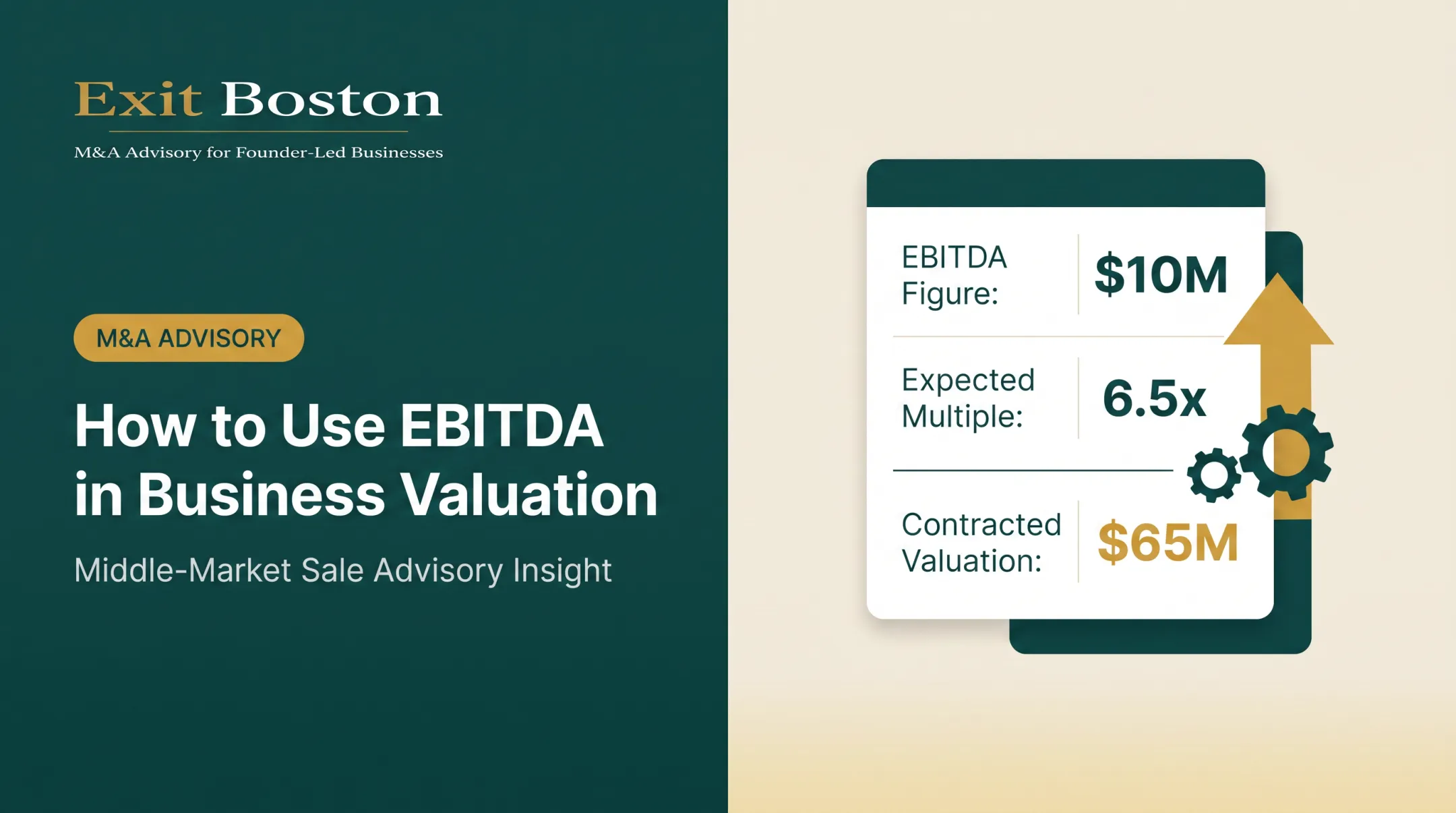
For companies above roughly $2M-$5M in EBITDA, EBITDA multiples become the standard. That makes this the most relevant method for middle-market sellers.
Example: A manufacturer with $4M in EBITDA and a 6x multiple lands around $24M.
Multiples also move sharply with deal size. Recent IBBA/M&A Source Market Pulse and Porter White & Co. manufacturing data show the spread:
| Source | Deal size | EBITDA multiple |
|---|---|---|
| IBBA Market Pulse | $2M-$5M value | 4.5x |
| IBBA Market Pulse | $5M-$50M value | 5.5x |
| Porter White (manufacturing) | $10M-$25M EV | 5.7x |
| Porter White (manufacturing) | $100M-$250M EV | 7.9x |

The takeaway: there is no single "right" multiple, only a range set by deal size, sector, and where your company sits in the market.
Industry Multiples Vary Widely, Why "Average" Can Mislead You
A blended national average is nearly useless once you look at real sector data:
| Industry | Multiple Range | Notes |
|---|---|---|
| Manufacturing | 5.7x - 7.9x EBITDA | Rises steadily with enterprise value |
| Distribution | ~7.4x EBITDA | Reported at $25M-$50M EV band |
| Food & beverage | Highly variable | Elevated in active M&A markets; multiples swing widely by deal |
Even within one industry, deal multiples can swing several points based on growth rate, customer concentration, and how many buyers are competing for the asset.
Exit Boston's own observed activity in New England metal fabrication, 2024 through mid-2026, shows the spread on an adjusted EBITDA basis: 4.0x to 4.5x for shops running below capacity on aging equipment with margins compressed from historical levels, 4.5x to 6.0x for well-run and profitable companies with manual or semi-automated production, and 8.0x to 9.0x for a small population with four things at once. Deep qualified backlog. Genuine recurring or program-of-record revenue. Automated production with documented throughput. Margins meaningfully above sector norms.
That top tier is not a rule of thumb outcome. On $3 million of adjusted EBITDA, the distance between the middle band and the top one is roughly $9 million of enterprise value, and no published average for the sector will tell an owner which band they are in.
Consider two manufacturing companies, each with $4M in EBITDA:
- Company A: Three customers drive 70% of revenue; the founder owns every client relationship
- Company B: Diversified customer base and a management team that can run without the owner
Buyers will pay very differently for these two businesses, even though the EBITDA line looks identical.

Why Rules of Thumb Fall Short for Middle-Market Sellers
Generic multiples ignore the factors that actually drive institutional buyer interest:
- Customer concentration and contract stability
- Recurring versus project-based revenue
- Depth and independence of the management team
- Brand equity and market position
- Operational systems and financial transparency Overvaluing your business based on an optimistic multiple scares off serious buyers and drags out your time on market. Undervaluing it leaves real money on the table. Neither outcome is acceptable when you're the one who built the company. Private equity firms, strategic acquirers, and family offices don't price deals off a published average. They run detailed diligence. A rule-of-thumb number rarely survives that process intact. The label company case in The Real Exit shows how far a real company can sit from its rule of thumb. Institutional buyers initially viewed the business as worth roughly 4.8x EBITDA, not because earnings were weak, but because it was overly dependent on its founder and lacked management incentives. After roughly six months addressing those structural gaps, it sold at 6.4x on $3.4 million of EBITDA, an enterprise value of $21.76 million against the founder's own expectation of about $16 million. A rule of thumb applied to the same earnings would have produced neither number. The rest of that story belongs to a different lever and a longer clock: under private equity ownership, three bolt-on acquisitions over 4.5 years took EBITDA from $3.4 million to $9.0 million and the exit multiple to 8.2x, and the founder's retained 20% stake brought his total realization to $32.2 million. Preparation moved the first 1.6 turns. Acquisitions and time moved the rest. Co-Founder Steve Vesey, who has spent over 25 years preparing business valuations, built Exit Boston's approach around this idea: buyers pay for how durable and transferable that earning power looks, not the earnings figure alone.

Getting an Accurate Valuation Before You Go to Market
Use a rule of thumb estimate for what it is: a directional starting point. Before you go to market, you need a professional valuation grounded in market intelligence and actual comparable transaction data.
Exit Boston's process combines a few concrete steps:
- Institutional-readiness assessment: identifying founder dependencies and gaps that suppress your multiple
- Financial analysis and modeling: building a clear, defensible earnings picture
- Target-buyer mapping: pinpointing which private equity firms, strategics, or family offices are likely to pay the highest premium
- Buyer-specific positioning: tailoring materials to each buyer's acquisition criteria
- Competitive tension: running a process among multiple qualified buyers, not just one

That process shows up in real outcomes. One Exit Boston client with $2.0M in EBITDA expected $8.0M-$10.0M and closed at $12.0M.
Across recent deals in water drilling, label printing, beer importing, and electrical contracting, results beat initial expected ranges by roughly 20% or more on average.
If you run a $10M-$100M revenue business, get a professional assessment before you start exit planning. A rule of thumb can sketch what your company could be worth. Only a buyer-backed process shows what the market will actually pay.
Frequently Asked Questions
What is a good rule of thumb for valuing a company?
A common shorthand is 2-4x EBITDA or 0.5-1x annual revenue, depending on industry. These figures vary widely by sector and deal size and should only be treated as a rough starting estimate.
How much is a business worth with $1 million in profit?
It depends heavily on your industry's typical multiple. At a 3x multiple, that's $3M; at 8x, that's $8M, and some high-growth sectors command even higher multiples.
How many times revenue is a company typically worth?
Revenue multiples vary by industry, recurring revenue strength, and margin profile, typically ranging from under 1x to several times revenue for high-growth, high-margin businesses.
Can I rely on a rule of thumb valuation to price my business for sale?
Not safely. Buyers conduct detailed diligence covering customer concentration, management depth, and earnings quality, factors a generic multiple simply can't anticipate.
When should I get a professional business valuation instead?
Once you're seriously considering a sale, recapitalization, or succession plan within the next 1-3 years, a professional valuation should replace any rule-of-thumb estimate.